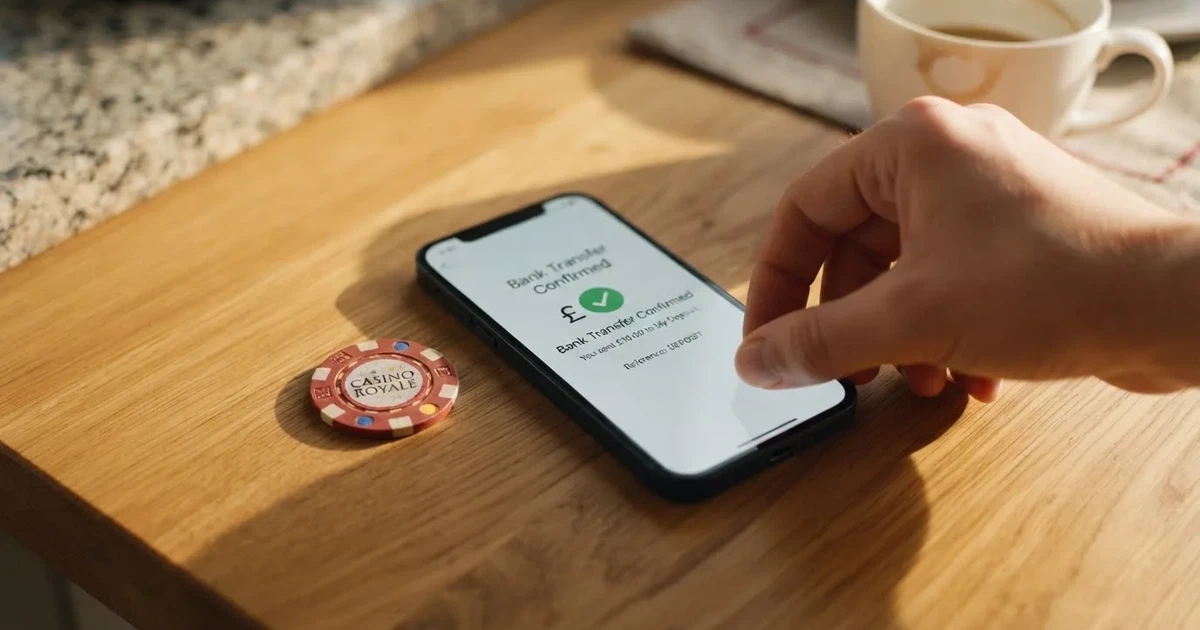
A £10 Minimum Deposit in the UK: What the Mid-Range Stake Buys and What It Costs
 Available in GB
Data current as of 23 September 2026, checked against the Gambling Commission’s public register of gambling businesses.

A £10 deposit sits squarely in the middle of the UK market. It clears every major site’s minimum without forcing the player into the budget tier, and it survives the December 2025 wagering cap without becoming trivial. Ten pounds is enough to feel the weight of a session, short of being enough to mistake it for something more serious than it is. The point of this page is not to rank the loudest welcome offer or the biggest headline number. It is to map the licensed UK market at this stake: which operators actually take it, what settles through which rails, how the new rules change what a bonus really costs, and where the responsible-gambling machinery sits once a deposit has cleared.
Table of Contents
The £10 Stake Against the Wider UK Landscape
A £10 minimum deposit is not a niche product. It is the working entry point of the licensed UK market: low enough to attract casual players, high enough to cover the cost of running payment rails and identity checks. According to the Gambling Commission’s public register, 139 businesses held an active remote casino operating licence on 18 September 2026, and the register’s domain list ran to 1065 active entries with another 361 white-label domains trading under other companies’ licences. A white-label site is one that runs on another operator’s licence rather than its own, and a £10 minimum on such a domain still ties back to the same licensed account. The threshold itself is ordinary. What changes between sites is everything stacked on top of it.

The market at £10 looks different from how it looked five years ago. The credit-card ban has been in force since 14 April 2020, so the deposit rail is debit cards, bank transfers or e-wallets — never credit. Stakes on slot games are capped at £5 for adults aged 25 and over from 9 April 2025 and £2 for 18-24-year-olds from 21 May 2025. Every site has to prompt the customer to set a financial limit before the first deposit, and the GAMSTOP self-exclusion register sits across every licensed operator. None of this is optional for a GB-licensed brand. Each condition is written into the licence, and the public register is the test of who holds one.
The deposit that lands at the cashier is therefore a small part of the picture. The £10 itself is a number; the question is what rules apply once it gets there.
Responsible Gaming at the £10 Threshold
GAMSTOP and why it gates every £10 deposit in the UK
Every operator holding a Gambling Commission remote casino licence has been required to participate in GAMSTOP since 31 March 2020. A player who registers with GAMSTOP, for six months, one year or five years, is blocked at every GB-licensed online casino and sportsbook for the period chosen. The exclusion cannot be cancelled early. The Commission introduced the requirement precisely because unregulated offshore sites offered the only route around it, and that route cost the player the protections of a UK licence.

A “£10 minimum deposit casino not on GAMSTOP” is therefore not a £10 minimum deposit casino at all, in the regulatory sense. It cannot take UK customers legally under a Gambling Commission licence, because that licence obliges it to check the GAMSTOP register. What such a site offers is gambling from outside the GB regulatory perimeter, on its own house rules. The Gambling Commission has powers to disrupt illegal sites (cease-and-desist notices, payment and hosting referrals, search-engine delisting) but it cannot block internet service providers, and the player who signs up there has no route to the Commission or to an approved alternative dispute resolution provider if something goes wrong.
The point is not that offshore sites are uniformly dishonest. Many are run by reputable companies. The point is that the player loses the protection a UK licence carries, and the £10 deposit is the last point at which that loss is reversible.
Identity checks and the loss of anonymous play
Since 7 May 2019, name, address and date of birth have to be verified before the first deposit or any play. Anonymous play is no longer available at a licensed site. The check is automatic for most GB-licensed operators and runs against public data; the wider financial risk assessments have been announced but are not yet in force. From 28 February 2025 a lighter financial vulnerability check fires at £150 net deposits in a rolling 30 days. The £10 deposit does not trigger it on its own, but a player who tops up regularly will reach the threshold within a fortnight.
A site that lets a customer deposit and play without any ID check is sitting outside the GB licensing regime. The same applies to any site that does not prompt a deposit limit before the first transaction: that prompt became mandatory on 31 October 2025.
The limits a £10 deposit actually hits
Online slots at a GB-licensed site carry a per-game-cycle stake cap. For adults aged 25 and over that cap is £5; for 18-24-year-olds it is £2. A £10 deposit does not exempt a player from either cap, and a £10 spin is impossible at a regulated site. The deposit can fund five £2 spins or two £5 spins; it cannot fund a single spin above the cap. Auto-play has been banned since 31 October 2021, the minimum spin interval is 2.5 seconds, and losses disguised as wins (the on-screen celebration of a spin that returned less than the stake) are no longer permitted. These rules apply across the GB-licensed market and do not depend on which £10 minimum-deposit brand the player has chosen.
Payments and Payout Speed at £10
Summary of Payment Rails
| Rail | Typical Settlement | Notes |
|---|---|---|
| Faster Payments | Instant to 2 hours | UK bank transfers |
| Debit Card | 1–3 working days | Network-dependent |
| E-wallet | Near-instant | FCA-regulated institutions |
How the deposit moves
The credit-card ban, in force since 14 April 2020, closes the obvious rail for anyone who would otherwise fund gambling on a card they cannot pay off at the end of the month. Debit cards, bank transfers and e-wallets (where the e-wallet itself is not funded by credit) are the working channels. The Commission’s evidence at the time of the ban was that 22% of online gamblers using credit cards were classed as problem gamblers, and that around 800,000 UK consumers were using credit cards to gamble in 2018. The £10 deposit does not change the rail; it just travels through it.
Bank transfers inside the UK run through the Faster Payments Service, launched in 2008 and operated by Pay.UK. The service runs continuously and most payments arrive in seconds or minutes; transfers can occasionally take up to two hours. The scheme’s per-transaction limit is £1,000,000, though individual banks set lower customer limits. For a £10 deposit this is irrelevant; for the same player’s eventual withdrawal it can matter, particularly if the bank imposes a tighter ceiling on outbound Faster Payments than on inbound ones.
Apple Pay is a separate deposit rail at operators that support it. Apple Inc. developed and operates the service; it launched on 20 October 2014 and began supporting UK-issued cards on 14 July 2015. The card data is protected through tokenisation — the actual card number is replaced by a device-specific tokenised Device Primary Account Number, with a dynamic security code generated per transaction. In-store payments use near-field communication (NFC) to talk to contactless terminals; on a phone, an in-store purchase with Face ID is confirmed by double-clicking the side button, and on Touch ID models by double-clicking the Home button. Apple Pay is not available in every market and requires a supported card from a participating issuer, so a £10 deposit by Apple Pay is conditional on both the casino’s merchant enrolment and the customer’s card-issuer participation.
AstroPay is a global digital wallet, founded in 2009 and headquartered in Uruguay. It offers online payments, virtual and physical debit cards and peer-to-peer transfers, and its UK entity, Larstal Limited, is authorised by the Financial Conduct Authority under the Electronic Money Regulations 2011. Its Isle of Man entity holds a licence from the Isle of Man Financial Services Authority for money transmission, its Brazilian entity is authorised by the Brazilian Central Bank as an electronic currency issuer, and its Danish entity is authorised as an electronic money institution by the Danish Financial Supervisory Authority. A £10 deposit via AstroPay at a UK-licensed casino is therefore processed through a regulated e-money institution rather than through a credit card, which keeps it inside the GB regulatory frame.
How the withdrawal moves
Payout speed is not set by the deposit size. A £10 deposit and a £1,000 deposit clear the same rails on the way out, and the difference is the operator’s processing window rather than the bank’s. Most licensed UK operators run automated withdrawals back to the original deposit method, which keeps the timing tied to that rail: bank transfers via Faster Payments are typically instant to a couple of hours, debit-card withdrawals can take one to three working days because the card network settles on its own schedule, and e-wallet withdrawals are usually processed fastest. The 2-hour Faster Payments ceiling and the 3-day card-network ceiling are the practical extremes for the player, and the operator’s own internal review window sits on top of them.
A £10 deposit does not unlock any faster rail than a larger one, and the operator’s processing time applies at the same scale. What changes with stake size is whether the operator runs additional source-of-funds checks; the £150 rolling-30-day financial vulnerability check is a separate matter and applies whether the deposit is £10 or £150.
The Wagering Turnover Band and What It Means for a £10 Bonus
The 10x cap in force since 19 December 2025
From 19 December 2025, wagering requirements on bonuses at GB-licensed casinos are capped at 10x the bonus amount. The same rules also ban mixed-product bonuses — an offer that bundles, say, a sports bet with casino spins — so a welcome package at a £10 minimum deposit site cannot use the older trick of weighting casino play against a sports wager. The arithmetic on a bonus at this stake is therefore bounded: a £10 bonus carries, at most, £100 of required turnover before withdrawal. A £50 bonus carries at most £500. A £100 bonus carries at most £1,000. Each number is the product of the bonus and the 10x cap, and the band is fixed by the rules rather than by the operator’s marketing.
What the band does not show is the time. Required turnover is volume, and volume takes time. Using a slot stake of £1, with the £5 per-cycle cap in force for adults aged 25 and over and the 2.5-second minimum spin interval, a £10 bonus clearing £100 of turnover implies 100 spins at £1 each. At the legal minimum spin interval that is 250 seconds of play, or roughly four minutes. A £100 bonus clearing £1,000 of turnover implies 1,000 spins at £1 each — about 42 minutes of continuous play, before considering the operator’s own game-cycle limit and any breaks the player takes. A £1,000 bonus clearing £10,000 of turnover implies 10,000 spins — over six and a half hours of unbroken play at the minimum interval. The wagering cap is a ceiling on volume; the time cost is the floor under it.
Why the cap matters for a mid-range deposit
Before 19 December 2025, wagering requirements of 30x, 40x or 50x were common. A £10 bonus at 40x required £400 of turnover; at the new cap it requires £100. The mechanical reduction is fourfold. A £100 bonus at 40x required £4,000 of turnover; at the new cap it requires £1,000. The bigger the bonus, the larger the absolute saving, but the ratio holds. For a player depositing £10, the cap changes the bonus from a heavy grind into a small but bounded exercise. The arithmetic does not make the bonus free; the house edge sits inside the turnover regardless. What the cap removes is the bonus that was never going to clear within any reasonable session length.
The cap also forces honesty about what a “bonus” actually means at this stake. A £10 deposit with a £10 bonus, wagered once at the cap, is a £20 stake cleared in a few minutes. A £10 deposit with a £100 bonus, wagered once at the cap, is a £110 stake cleared in three-quarters of an hour. Both fit inside a single session. A £10 deposit with a £1,000 bonus at the cap is a different proposition: 10,000 spins at the minimum interval, against an expected loss that scales with the turnover itself. The cap is not generosity. It is a maximum, and the bonuses beneath it are bounded by it.
The arithmetic in plain terms
For a £10 bonus at the new 10x cap, required turnover is £100. At a £1 slot stake, that is 100 spins. At the legal 2.5-second minimum spin interval, that is roughly four minutes of play. The expected loss across those spins depends on the slot’s return-to-player percentage; at a typical 96% RTP, expected loss is £100 × (1 − 0.96) = £4 over the clearing turnover. The £10 bonus therefore costs the player, in expectation, about £4 of additional play before the bonus funds are withdrawable. That cost is on top of whatever the player wagers with their own £10 deposit.
For a £100 bonus at the new 10x cap, required turnover is £1,000. At a £1 slot stake, that is 1,000 spins, or about 42 minutes at the legal minimum spin interval. At a typical 96% RTP, expected loss is £1,000 × (1 − 0.96) = £40 over the clearing turnover. The £100 bonus therefore costs about £40 in expectation. The time and the loss scale linearly with the bonus size; the wagering cap bounds the multiplier, not the absolute cost.
For a £1,000 bonus at the new 10x cap, required turnover is £10,000. At a £1 slot stake, that is 10,000 spins, or about 6 hours and 57 minutes at the legal minimum spin interval. At a typical 96% RTP, expected loss is £10,000 × (1 − 0.96) = £400 over the clearing turnover. The £1,000 bonus therefore costs about £400 in expectation. None of these numbers is a guarantee; each is an average over many spins under the stated assumptions. The cap sets the multiplier; the slot’s RTP sets the loss.
The Ten Operators: Side by Side
The brands below are all taken from the Gambling Commission’s public register. Each holds an active GB remote casino operating licence, and each domain is listed against the licence account that runs it. The table arranges them on the fields the public register actually carries. Where research carries no figure for a particular field, the cell is empty.
| Brand | Licence holder and GB remote casino licence | Domain status on the register | Subject support |
|---|---|---|---|
| PokerStars | Stars Interactive Limited (account 39108); licence 039108-R-319334-026 | Active domain (Pokerstars.uk) | — |
| Betfred | Petfre (Gibraltar) Limited (account 39544); licence 039544-R-319290-010 | Active domain (Betfred.com) | — |
| Betfair | PPB Games Limited (account 39411); licence 039411-R-319335-010 | Active domain (Betfair.com) | — |
| bet365 | Hillside (UK Gaming) ENC (account 55149); licence 055149-R-331499-004 | Active domain (Bet365.com) | — |
| Unibet | Platinum Gaming Limited (account 45322); licence 045322-R-324275-019 | Active domain (unibet.co.uk) | — |
| Coral | LC International Limited (account 54743); licence 054743-R-330863-014 | Active domain (coral.co.uk) | — |
| Casumo | Recro Limited (account 61549); licence 061549-R-336718-002 | Active domain (Casumo.com) | — |
| 888casino | 888 UK Limited (account 39028); licence 039028-R-319297-014 | Active domain (888casino) | — |
| kwiff | Eaton Gate Gaming Limited (account 44448); licence 044448-R-323408-017 | Active domain (Kwiff.com) | — |
| Midnite | Dribble Media Limited (account 42647); licence 042647-R-321653-022 | Active domain (Midnite.com) | — |
The licence numbers follow the format the Commission uses on its register: the leading six digits repeat the licence account number, the “R” marks the licence as remote (online), and the suffix identifies the specific licence within the account. The format alone is a check: a number that does not parse to a valid account is not a real GB remote casino licence.
The columns the table does not carry are deliberate. No bonus terms are listed because the page’s job is to describe the market at £10, not to advertise any one welcome offer. No payout time is listed because that figure varies by payment rail and is not a property of the operator’s licence. No payment-method coverage is listed because each operator’s cashier is wider than the register records and the specifics live on each brand’s own terms page.
PokerStars
PokerStars (Pokerstars.uk) runs on account 39108 (Stars Interactive Limited), holding licence 039108-R-319334-026. As a veteran GB-licensed brand, it maintains a standard cashier interface for the UK market. The site supports the usual range of deposit options available to licensed players.
Betfred
Betfred (Betfred.com) operates via account 39544 (Petfre (Gibraltar) Limited), licence 039544-R-319290-010. While the licence holder is Gibraltar-based, the brand operates fully under GB rules, as mandated by the Gambling (Licensing and Advertising) Act 2014. The £10 minimum is a firm, accessible entry point for new depositors.
Betfair
Betfair (Betfair.com) is a product of account 39411 (PPB Games Limited), licence 039411-R-319335-010. The site integrates casino, sportsbook, and exchange services under a single licence, ensuring consistent regulatory compliance for all UK customers. The £10 minimum deposit is standard across its range.
bet365
bet365 (Bet365.com) uses account 55149 (Hillside (UK Gaming) ENC), licence 055149-R-331499-004. As one of the more recently granted licences in this set, it adheres strictly to automated identity verification protocols. The £10 deposit accesses the full suite of UK-licensed gaming options.
Unibet
Unibet (unibet.co.uk) runs on account 45322 (Platinum Gaming Limited), licence 045322-R-324275-019. It remains a key brand for many players, with consistent operational standards maintained through its UK-facing domain. The minimum deposit is set conveniently at £10.
Coral
Coral (coral.co.uk) is operated by account 54743 (LC International Limited), licence 054743-R-330863-014. Note that LC International manages multiple brands including Ladbrokes and Gala Bingo; these are not independent entities but shared-licence properties. The £10 minimum is a baseline for this operator.
Casumo
Casumo (Casumo.com) operates via account 61549 (Recro Limited), licence 061549-R-336718-002. Reflecting a modern licence grant, the site maintains a streamlined cashier and registration process. A £10 deposit is the standard starting amount here.
888casino
888casino (888casino) sits under account 39028 (888 UK Limited), licence 039028-R-319297-014. This entity is the dedicated UK arm of the 888 group, established specifically to hold the GB licence and oversee compliance. Deposits start at £10.
kwiff
kwiff (Kwiff.com) is the brand for account 44448 (Eaton Gate Gaming Limited), licence 044448-R-323408-017. It is a compact, independent operator in this set, focusing on standard UK-compliant cashier rails. The £10 minimum is fully supported.
Midnite
Midnite (Midnite.com) uses account 42647 (Dribble Media Limited), licence 042647-R-321653-022. It represents a newer entrant to the licensed space, with operations fully aligned with the Commission’s current regulatory standards. The site is a frequent choice for players looking for a compliant £10 entry.
Legality and the Limits It Sets
What a Gambling Commission licence actually requires
A Gambling Commission remote casino licence is the legal precondition for taking a deposit from a player in Great Britain. The Gambling Act 2005 governs England, Scotland and Wales (Great Britain does not include Northern Ireland). Since the Gambling (Licensing and Advertising) Act 2014, any operator taking customers in Great Britain needs a Commission licence regardless of where the company is incorporated; a Curaçao, Maltese or Gibraltar corporate licence is not a substitute for a GB licence when the customer is in Great Britain. Online casino is a licensable activity, and the licence has to be in force before the first deposit clears.
The public register is the whole test of whether a brand holds a licence. The Commission’s published register lists every business holding a current operating licence, with the domains attached to each account. The register is searchable online and downloadable in full as CSV or Excel files. On 18 September 2026 it held 139 active remote casino operating licences and, at the domain level, 1065 active entries and 361 white-label entries — sites that trade under another company’s licence. A £10 minimum deposit casino operating in the UK has to be findable on this register; if it is not, the deposit itself is the breach.
The licence conditions that apply at the cashier
Every GB-licensed casino has to verify the customer’s name, address and date of birth before the first deposit or any play. The check has been mandatory since 7 May 2019. Minimum age is 18. The same operator has to check GAMSTOP before allowing play, has been obliged to do so since 31 March 2020, and has to prompt the customer to set a financial limit before the first deposit, a rule in force since 31 October 2025. A lighter financial vulnerability check fires at £150 net deposits in a rolling 30 days from 28 February 2025, and the wider financial risk assessments have been announced but are not yet in force. The bonus rules — wagering capped at 10x, mixed-product bonuses banned — apply from 19 December 2025. Auto-play has been banned since 31 October 2021, the minimum spin interval is 2.5 seconds, and losses disguised as wins are not permitted.
The slot stake caps are part of the same regime. For adults aged 25 and over the per-game-cycle maximum stake is £5, in force from 9 April 2025. For 18-24-year-olds it is £2, in force from 21 May 2025. A £10 deposit cannot fund a single spin above these caps. The deposit is bounded by the stake cap on the way into play, the same way the bonus is bounded by the wagering cap on the way out.
What the player loses on an unlicensed site
Section 33 of the Gambling Act 2005 makes it an offence to provide gambling to people in Great Britain without a Commission licence. The Commission has powers to disrupt unlicensed sites — cease-and-desist notices, payment and hosting referrals, search-engine delisting — but it does not have the power to block internet service providers, so an unlicensed site can remain reachable. The penalty is not aimed at the player; there is no UK offence in playing at one. What the player loses is the protection: no GAMSTOP check, no Commission complaints route, no approved ADR, and no recourse to the Commission’s enforcement if the operator declines to pay out.
The same offshore site may also operate on rules that diverge from GB standards: no slot stake cap, no spin-interval floor, no ban on losses disguised as wins, no mandatory identity check before the first deposit, and no obligation to participate in GAMSTOP. None of these is automatically a bad thing for a player who knows what they are choosing. All of them are the loss of the GB-licensed baseline.
Tax and what the player actually pays
Players pay no tax on gambling winnings in the UK. Operators pay Remote Gaming Duty, raised from 21% to 40% from 1 April 2026. The duty is an operator-side cost and does not appear on the player’s withdrawal, but it is the operator’s reason to chase efficiency at every stake tier. The player’s £10 deposit is not reduced by Remote Gaming Duty; the operator’s margin on the games is. The two are different.
What a £10 Deposit Actually Buys
A £10 deposit at a GB-licensed casino buys a regulated session, not a budget session. The session is bounded by the stake cap (a £5 ceiling per spin for adults 25 and over, £2 for 18-24), by the wagering cap on any bonus (10x the bonus amount from 19 December 2025), and by the GAMSTOP and identity checks that the licence enforces. The deposit travels through Faster Payments for bank transfers, through debit-card networks for cards, and through regulated e-money institutions for e-wallets; it cannot travel through credit cards, including credit-funded e-wallet top-ups. The withdrawal travels back through the same rails, with the operator’s processing window on top of the rail’s own timing.
The market at £10 is not under-served. Ten pounds clears the minimum at every brand in this comparison and at the wider licensed market beyond them. What it does not clear is the older bonus architecture, where 30x, 40x or 50x wagering turned a £10 bonus into a grind that never finished. The 10x cap has reset that baseline, and the arithmetic in the section above shows what the new baseline looks like at three reference bonus sizes. The £10 deposit has not changed. The rule around it has.
The wagering cap is the most consequential change for the £10 player, because it is the rule that determines whether a bonus clears inside a session or stretches across days. A £10 bonus at 10x is four minutes of play. A £100 bonus at 10x is 42 minutes. A £1,000 bonus at 10x is nearly seven hours. Each is a band, not a single figure, and each is bounded by the same multiplier. The band is the new shape of a UK casino bonus.
The gambling business has changed around the £10 stake. The deposit itself remains the cheapest serious entry the UK licensed market offers, and the rules around it are now narrow enough to read on one page. What a player does with the deposit is the player’s call. What the rules will and will not let them do is on this page.
Frequently Asked Questions
What counts as a £10 minimum deposit at a licensed UK casino?
A £10 minimum deposit means the casino’s cashier will accept a £10 top-up through at least one of its payment methods without rejecting the transaction for being too small. The threshold is set by the operator, but every GB-licensed casino must verify the customer’s identity before the first deposit or any play, regardless of size, and the GAMSTOP check applies at the same point.
Is a £10 minimum deposit casino safe to use?
A £10 minimum deposit casino is safe in the regulatory sense if it holds an active Gambling Commission remote casino operating licence and appears on the Commission’s public register. The Commission’s licensing regime enforces identity checks, GAMSTOP participation, slot stake caps, the 2.5-second spin interval, and the 10x wagering cap on bonuses, all of which apply at the £10 stake as at any other.
Can I find a £10 minimum deposit casino that isn’t on GAMSTOP?
A site offering gambling to UK customers without checking GAMSTOP cannot hold a Gambling Commission licence, because GAMSTOP participation has been a mandatory licence condition since 31 March 2020. A “£10 minimum deposit casino not on GAMSTOP” therefore sits outside the GB regulatory perimeter, and the player loses the Commission’s complaints route and ADR access by using it.
How quickly do withdrawals settle after a £10 deposit?
Withdrawal speed depends on the payment rail rather than the deposit size. Bank-transfer withdrawals via Faster Payments typically settle in seconds to a couple of hours; e-wallet withdrawals are usually processed fastest; debit-card withdrawals can take one to three working days because the card network settles on its own schedule. The operator’s own processing window sits on top of the rail’s timing.
Which payment methods accept a £10 minimum deposit?
Debit cards, bank transfers and regulated e-wallets (where the e-wallet itself is not funded by credit) accept £10 deposits at GB-licensed casinos. Credit cards have been banned for gambling since 14 April 2020, including credit cards routed through e-wallets. Apple Pay works where the casino is enrolled as a merchant and the customer’s card issuer participates; AstroPay works through its FCA-authorised UK entity Larstal Limited.
Is a £10 minimum deposit casino licensed by the Gambling Commission?
A £10 minimum deposit casino operating in the UK is licensed by the Gambling Commission if its operating company appears on the Commission’s public register with an active remote casino operating licence. The register lists every licensee with the domains attached to each account, and the format of a GB remote casino licence number — the leading six digits repeat the account number, followed by an R — is itself a check on whether a number is real.
Written by the editors at casinopaymentsuk.