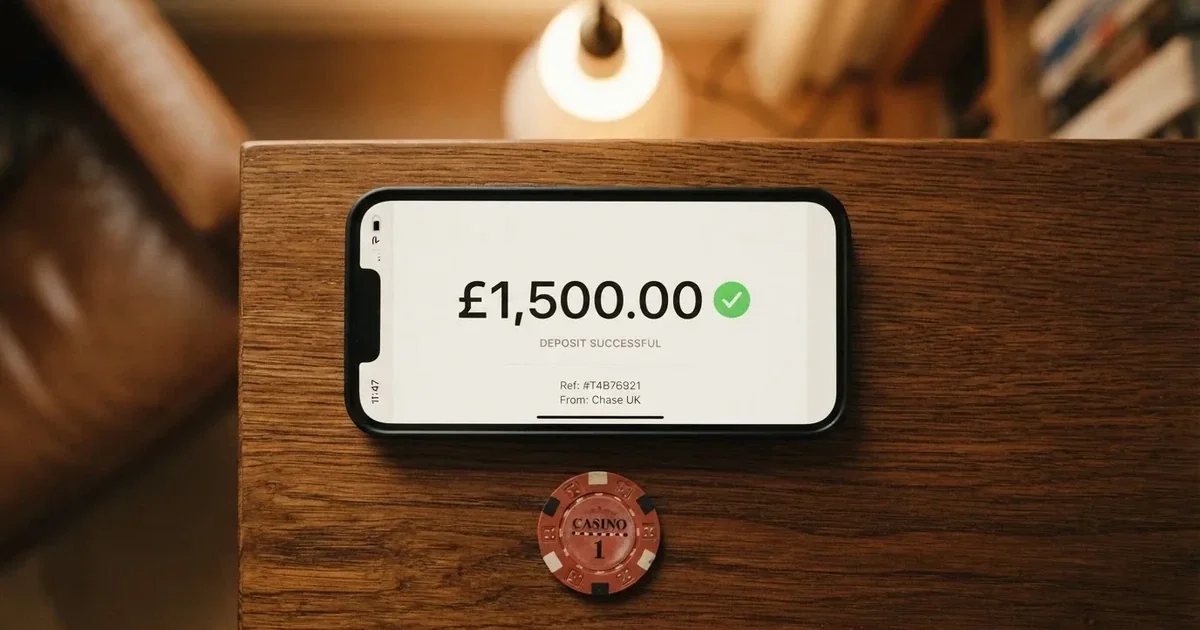
Best casino app UK: what the licensed apps actually offer in 2026
 Available in GB
A “best casino app” page can mean almost anything. Some readers want the smoothest touchscreen, some want Apple Pay at the cashier, others want to know whether the bonus in the inbox is worth clearing. The honest answer is that the licence behind the app matters more than the app itself — a casino app still has to carry a Gambling Commission licence before it may take a UK deposit, and the safest apps are simply the licensed ones with clear self-exclusion tools. Apple Pay or PayPal availability depends on the operator rather than on the download. What follows is a ranking built around that premise: ten apps running on GB remote casino licences, compared on the criteria that change a session — the cashier, the bonus terms, the safer-play controls.

Current as of 23 September 2026 against the Gambling Commission’s public register of gambling businesses (CSV download).
Table of Contents
- Casino apps on a phone: what the download actually does
- How the ten licensed apps stack up
- UK casino app legality: the licence is the test
- Safer play on a casino app: what the licensed apps are required to carry
- Payments and payout speed on a UK casino app
- Welcome bonuses and the 10x cap: what an offer really costs
- The ten apps, reviewed
- What a UK casino app still cannot do
- What the ranking is, and what it is not
- Frequently asked questions about UK casino apps
Casino apps on a phone: what the download actually does
A casino app is, at heart, a website drawn for a touchscreen. Most of the licensed UK brands offer a download for iOS and Android rather than forcing players through a mobile browser, and the practical question is what the wrapper adds: portrait or landscape handling, biometric login, push notifications for free-spins drops, a smaller, faster build of the lobby. None of that changes the math of a slot spin or the terms of a welcome offer.

What the app does not change is the licence. Every brand in this ranking holds a Gambling Commission remote casino operating licence, which — unlike an app store rating — brings GAMSTOP self-exclusion, the credit-card ban, the £5 stake cap on online slots for adults, and the dispute route if something goes wrong. A polished download from an offshore operator offers none of those protections.
Two practical consequences. First, a UK player who has self-excluded through GAMSTOP is excluded at every licensed app and cannot route around it through a different download. Second, anonymous play is not possible at a licensed site — name, address and date of birth are verified before the first deposit or any play, a rule that has been in force since 7 May 2019.
The point of this ranking is to compare the licensed apps on the things a reader can actually weigh: the cashier, the bonus, the safer-play tools, the licence behind the brand.
How the ten licensed apps stack up
Ten brands, all of them on the Gambling Commission register as either an active or a white-label domain of a remote casino operating licence, are set out side by side in the table below. The ordering follows the rank this page assigns them; each row carries the licence holder, the licence number, the domain status and a plain marker for whether research confirms casino-app-specific subject support (which, in this set, none of them do).

| Brand | Licence holder and GB remote casino licence | Domain status on the register | Subject support |
|---|---|---|---|
| Paddy Power | PPB Games Limited · 039411-R-319335-010 | Active | — |
| kwiff | Eaton Gate Gaming Limited · 044448-R-323408-017 | Active | — |
| Betway | Betway Limited · 039372-R-319367-029 | Active | — |
| bet365 | Hillside (UK Gaming) ENC · 055149-R-331499-004 | Active | — |
| Unibet | Platinum Gaming Limited · 045322-R-324275-019 | Active | — |
| 888casino | 888 UK Limited · 039028-R-319297-014 | Active | — |
| Virgin Games | Gamesys Operations Limited · 038905-R-319430-022 | White Label | — |
| Midnite | Dribble Media Limited · 042647-R-321653-022 | Active | — |
| Betfred | Petfre (Gibraltar) Limited · 039544-R-319290-010 | Active | — |
| BetVictor | BV Gaming Limited · 039576-R-319370-028 | Active | — |
A few things the table carries without saying. Every licence number takes the form account-R-number–suffix: the leading six digits repeat the licence holder’s account number, the “R” marks a remote (online) licence, and the suffix ties a specific licence activity to that account. A white-label site — Virgin Games is the one here — trades under another company’s licence rather than holding its own; the player experience is run by the white-label partner, but the Commission licence, the GAMSTOP link and the ADR route all sit with the licence holder.
No row claims casino-app-specific subject support. The page can list ten licensed apps and rank them on the criteria that matter, but it cannot, on the evidence research carried, confirm an app-store-specific feature for any one of them — a fact any reader should weigh against a marketing line that says otherwise.
UK casino app legality: the licence is the test
A casino app offered to a UK player is regulated by the Gambling Commission under the Gambling Act 2005, which covers Great Britain (England, Scotland and Wales) and not Northern Ireland. Since the Gambling (Licensing and Advertising) Act 2014, any operator taking customers in Great Britain needs a Commission licence wherever it is based; a Curaçao, Maltese or Gibraltar licence is not a substitute for taking UK play.
The public register is the whole test of whether a brand holds a licence. On 18 September 2026 it listed 139 businesses holding an active remote casino operating licence, and 1065 active and 361 white-label domain entries across the same set of licensees. The register is searchable online and downloadable as CSV or Excel. If a brand cannot be found on it, the brand is not licensed to take a UK deposit, however convincing its app store listing looks.
Providing gambling to people in Great Britain without a Commission licence is an offence under section 33 of the Gambling Act 2005. The Commission’s enforcement is real but limited: cease-and-desist notices, search-engine delisting, payment and hosting referrals. It has no power to block at the ISP level. The penalty is not aimed at the player — what the player loses on an unlicensed site is protection. There is no GAMSTOP coverage there, no Commission complaints route, no approved ADR, and the credit-card ban and the stake cap do not apply. The deposit may go in; the recourse does not.
A few practical boundaries worth keeping in mind:
- Minimum age 18. Identity verification runs before the first deposit or any play.
- Slots stake cap. £5 per game cycle for adults aged 25 and over, from 9 April 2025; £2 for 18–24-year-olds, from 21 May 2025. The cap sits inside the slot, not at the cashier — it is the bet size, not the deposit ceiling.
- No credit cards. From 14 April 2020 the Gambling Commission banned credit cards for gambling across all online and offline products in Great Britain, including credit cards routed through e-wallets. Debit cards and bank transfers were unaffected.
- No auto-play. From 31 October 2021 auto-play is banned on slots, a spin may not be faster than 2.5 seconds, and losses disguised as wins are banned.
- Deposit limit prompt. There is no state-set deposit ceiling. Operators must, from 31 October 2025, prompt every new customer to set a financial limit before the first deposit goes through.
- Tax. Players pay no tax on gambling winnings in the UK. Operators pay Remote Gaming Duty, raised from 21% to 40% from 1 April 2026.
The stake cap and the bonus cap are the two numbers that shape how an offer feels, and they sit in different places. The stake cap is a per-spin ceiling inside the slot. The bonus cap is the wagering requirement the operator may attach to a welcome package. From 19 December 2025 the Commission capped wagering requirements at 10x and banned mixed-product bonuses (the “bet on sport, get casino spins” pattern). The combination — a low stake cap and a low bonus multiple — is what makes a UK welcome offer structurally different from an offshore one, and the calculation later on this page turns that difference into a number.
Safer play on a casino app: what the licensed apps are required to carry
Safer-play on a UK casino app is not a feature the operator can opt into; it is a set of conditions attached to the licence. The minimum list, and the part that a reader should look for on the app before the first deposit, looks like this.
GAMSTOP self-exclusion. Every online GB-licensed operator must take part in GAMSTOP, the national online self-exclusion scheme. Self-exclusion periods are six months, one year or five years; once chosen, the period cannot be cancelled early, and the exclusion applies across every participating operator in a single registration. Since 31 March 2020 GAMSTOP has been a mandatory licence condition rather than a voluntary scheme.
Financial vulnerability prompts. From 28 February 2025, operators run a financial vulnerability check at £150 in net deposits over a rolling 30-day window, using public data only. The wider financial risk assessments have been announced but are not yet in force. The check is not a credit search and does not add a footprint to the customer’s file; it is a soft prompt that asks the operator to look again.
Reality checks and time-out. A reality-check pop-up in a slot, configurable by the player, has been a Commission requirement for years. A time-out — a 24-hour to several-week break — sits one tap away from the responsible-gaming page of every licensed app, alongside the longer self-exclusion route.
National Gambling Helpline. GamCare runs the National Gambling Helpline; GambleAware funds treatment and research. Every licensed app carries a link, on every page, to the helpline and to the self-exclusion scheme.
The test the page proposes is small and unromantic: open the responsible-gaming section of the app before the first deposit and confirm that GAMSTOP registration is reachable in two taps or fewer. If it is, the licence is doing what it is supposed to. If it is not, the app is the wrong one, however good its bonus looks.
Payments and payout speed on a UK casino app
A casino app’s cashier is where the licence becomes useful or stops mattering. Two pieces move: the deposit side, where the brand of the wallet or card matters, and the withdrawal side, where the rail matters more than the brand.
Apple Pay inside a casino app
Apple Pay is developed and operated by Apple Inc. and launched on 20 October 2014, initially supporting only US-issued payment cards. UK-issued card support followed on 14 July 2015. The system replaces the actual card number with a device-specific tokenised Device Primary Account Number and generates a dynamic security code for each transaction — the merchant never sees the underlying PAN. In-store payments use near-field communication to talk to a contactless terminal; in-app payments sit inside the same tokenisation layer but route through the merchant’s payment gateway rather than NFC.
Apple Pay requires a supported card from a participating issuer, and Apple Pay is not available in every market. On iPhones with Face ID, in-store purchases are authenticated by double-clicking the side button; on Touch ID models, by double-clicking the Home button. The card itself stays a debit or credit card as far as the Gambling Commission’s 14 April 2020 ban is concerned: a credit card funded through Apple Pay is still a credit-card transaction and a licensed UK app will not accept it.
Whether a casino app supports Apple Pay at the cashier is an operator decision, not an Apple one. Where it does, the experience is what an iPhone user already knows — a biometric confirmation, no card number typed in. Where it does not, the deposit falls back to a debit card or to a bank transfer.
PayPal and other wallets
PayPal works inside licensed UK apps at the operator’s discretion. The same caveat as Apple Pay: availability is set by the casino, not by PayPal. Where PayPal is accepted, the deposit goes through as a wallet transfer rather than as a card transaction, and the credit-card ban does not bite — PayPal-funded deposits pull from the linked balance or from a linked debit card.
AstroPay is a third option, less common on UK apps than Apple Pay or PayPal. The UK entity behind AstroPay is Larstal Limited, an electronic money institution authorised by the Financial Conduct Authority under the Electronic Money Regulations 2011. The wallet itself was founded in 2009 and is headquartered in Uruguay, with further entities on the Isle of Man (AstroPay Global, licensed by the Isle of Man FSA), in Brazil (authorised by the Brazilian Central Bank as an electronic currency issuer) and in Denmark (authorised by the Danish FSA). AstroPay also operates as a global digital wallet offering online payments, virtual and physical debit cards, and peer-to-peer transfers, and spun off its payment-processing business, dLocal, as a separate company in 2016. Its UK authorisation is what matters inside a GB-licensed app: the deposit goes through an FCA-regulated e-money institution rather than an opaque intermediary.
Bank transfers and Faster Payments
UK bank transfers inside a casino app typically move through the Faster Payments Service, launched in 2008 and operated by Pay.UK. The scheme runs 24 hours a day, seven days a week, and most payments arrive instantly or within a couple of minutes, though transfers can occasionally take up to two hours. The per-transaction limit on Faster Payments is £1,000,000, though individual banks impose lower limits on their customers.
The Bank of England is not a direct participant in Faster Payments but is responsible for overseeing the system’s safety and stability and for providing final settlement. For a player, the practical question is whether the deposit lands instantly (it usually does) and whether the withdrawal comes back through the same rail (most licensed apps now do). A withdrawal is a separate transaction from a deposit: it goes out of the operator’s bank, into the player’s, and the time depends on the operator’s processing window rather than on the rail.
What a casino app withdrawal actually costs in time
The honest framing: the rail sets the floor, the operator sets the ceiling. A Faster Payments withdrawal to a UK bank is mechanically capable of clearing in minutes. The figure a player sees — “1–3 working days”, “instant”, “24 hours” — describes the operator’s processing window, which is the time between the player requesting the withdrawal and the operator instructing the bank. A brand that holds withdrawals for review, or one that requires a withdrawal to be made to the same payment method as the deposit (a Commission anti-money-laundering expectation), can stretch that window regardless of the rail.
Two numbers worth keeping. The Commission’s no-credit-card rule is a deposit-side rule: it does not delay a withdrawal to a debit card, and it does not push the withdrawal to a different rail. The £150-in-30-days vulnerability check is a soft prompt, not a hold on a withdrawal, and runs against public data only.
Welcome bonuses and the 10x cap: what an offer really costs
A welcome bonus on a UK casino app is a different animal from one on an offshore site. The mechanics are the same — a match on the first deposit, a number of free spins on a named slot — but the wagering requirement is capped, since 19 December 2025, at 10x the bonus. Mixed-product bonuses (the “bet on sport, get casino spins” pattern) are banned in the same rule. The cap is on the wagering requirement, not on the size of the bonus; the size of the bonus is still set by the operator.
What 10x means in practice is the calculation that follows.
A wagering turnover band
The arithmetic on this page works as a band rather than a single number because the bonus size is the operator’s choice and the stake per spin is the player’s. The fixed quantity is the wagering multiple.
Take a bonus of £100 at the 10x cap. Required turnover is £100 × 10 = £1,000. At a stake per spin of £5 (the £5 stake cap on online slots for adults aged 25 and over), the player needs £1,000 ÷ £5 = 200 spins to clear the bonus; at £2 (the £2 cap for 18–24-year-olds), 500 spins. The two numbers straddle what a single bonus actually requires, and the band reflects that.
The band does not end with a verdict on whether the offer is “good”. It ends with the time the clearing takes: at a 2.5-second minimum spin interval (the Commission has banned faster spins since 31 October 2021), 200 spins takes 500 seconds, and 500 spins takes 1250 seconds. This is the time to clear the bonus assuming only the bonus amount is wagered, and a player who plays through the deposit as well runs several times longer.
| Bonus size | Required turnover (10x) | Spins at £5 stake | Spins at £2 stake | Time at 2.5s/spin (low–high) |
|---|---|---|---|---|
| £20 | £200 | 40 | 100 | 1 min 40s – 4 min 10s |
| £50 | £500 | 100 | 250 | 4 min 10s – 10 min 25s |
| £100 | £1,000 | 200 | 500 | 8 min 20s – 20 min 50s |
| £200 | £2,000 | 400 | 1,000 | 16 min 40s – 41 min 40s |
The band is wide because the inputs are. A £20 bonus at the £5 stake clears in well under two minutes; a £200 bonus at the £2 stake clears in three-quarters of an hour. Most licensed welcome offers sit between £20 and £100 in matched cash, with free spins added on top; the figure the player actually clears depends on the offer they take and on whether the free-spin winnings carry their own wagering requirement (under the 10x cap they must, by definition).
A second number the calculation does not produce, and should not be claimed to produce: the expected loss over the clearing period. That depends on the RTP of the slot, which is not fixed across the offer. The closest the page will come is the qualitative point — clearing a £100 bonus at 10x on a 96% RTP slot has an expected cost in the low single-digit pounds before any actual wins, but the figure varies by title and by how the free spins are configured.
The ten apps, reviewed
Each block below covers a single brand. The licence line is the same fact each time and is stated once, in full, in the section that owns it; here it is referred to by name rather than re-printed. The verdict at the end of each block is this page’s judgement of the brand, on the criteria above it, and is the answer the licence line and the cashier list alone do not provide.
Paddy Power
Paddy Power operates under a Gambling Commission remote casino licence held by PPB Games Limited, and is listed as an active domain of that account. The brand is a familiar face in UK betting shops and has carried that identity into the app, with the casino tab sitting beside the sportsbook. The app is the workhorse option for players seeking a single, integrated platform for casino and sports.
The verdict is straightforward. Paddy Power is the right choice for a reader who wants casino play alongside sports betting inside one licensed app and does not want a smaller brand at the cashier.
kwiff
kwiff is licensed by the Gambling Commission for remote casino activity via Eaton Gate Gaming Limited, with kwiff listed as an active domain. The brand is newer than most in this set and has built its identity around a “surprise” stake multiplier on selected bets — a marketing line that translates into variable RTP on the casino side and is worth reading as such.
The verdict is narrower. kwiff suits a player who likes the variable-stake wrinkle and is comfortable with a younger brand; for a player who wants the broadest lobby, a more established name is the safer pick.
Betway
Betway holds a Gambling Commission remote casino operating licence via Betway Limited, with the Betway domain listed as active. The brand has carried a sportsbook-led identity for years and the casino app is a credible second string rather than the centrepiece. The cashier is familiar — debit cards, the common e-wallets — and the app itself is built for fast switching between sports and casino.
The verdict: Betway is a strong choice for those wanting casino play as part of a wider sportsbook-focused experience.
bet365
bet365 operates under a Gambling Commission remote casino licence held by Hillside (UK Gaming) ENC, with bet365 listed as an active domain. The brand is one of the larger in the UK by customer numbers and the app carries that weight in its lobby size and in the depth of its live-dealer product. The cashier is the standard set, and the in-play switching between sports, casino and games is the part the app has been built around.
The verdict: bet365 is the top choice for those prioritising lobby depth and a comprehensive live-dealer catalogue over other considerations.
Unibet
Unibet is licensed by the Gambling Commission for remote casino activity under Platinum Gaming Limited, with Unibet listed as an active domain. The brand is one of the longer-established European sportsbooks and its UK casino app carries the same broader-international flavour. The cashier is the standard set and the safer-play tools sit where the Commission’s LCCP requires them to sit.
The verdict: Unibet fits those who value a European-established brand and a predictable, clean layout.
888casino
888casino holds a remote casino operating licence from the Gambling Commission via 888 UK Limited, with 888casino listed as an active domain. The brand has been a casino-first name for the length of its UK life and the app reflects that — the home screen is a casino lobby, not a sportsbook with a casino tab. The cashier is the standard set and the brand’s own games sit alongside third-party slots in the lobby.
The verdict: 888casino is ideal for those who want an app dedicated to casino play rather than a multi-product tab-based interface.
Virgin Games
Virgin Games trades under a remote casino operating licence held by Gamesys Operations Limited; Virgin Games is listed on the register as a white-label domain. The Virgin brand brings a different feel at the front of the app, but the licence, the safer-play tools and the dispute route sit with the licence holder.
The verdict: Virgin Games suits a reader who likes the Virgin brand identity and is comfortable with the white-label structure. A reader who prefers the brand and the licence to be the same legal entity should look elsewhere in the set.
Midnite
Midnite holds a remote casino licence from the Gambling Commission via Dribble Media Limited, with the Midnite domain listed as active. The brand is a newer entrant into the UK casino space and has built its identity around a darker visual style and a tighter lobby than the bigger names. The cashier carries the standard payment set.
The verdict: Midnite is the choice for a reader who wants a smaller, design-led app and is comfortable with a younger brand at the cashier. A reader who values catalogue depth and an established track record should pick higher up the list.
Betfred
Betfred is licensed by the Gambling Commission for remote casino activity via Petfre (Gibraltar) Limited, with the Betfred domain listed as active. The brand has a long UK high-street identity and the app mirrors it — a sportsbook-led home screen with a casino tab alongside. The cashier is the standard set.
The verdict: Betfred fits a reader who wants a high-street name on the phone and is happy with the casino as a tab rather than as the product. A casino-first reader is better served elsewhere.
BetVictor
BetVictor operates under a Gambling Commission remote casino licence held by BV Gaming Limited, with the BetVictor domain listed as active. The brand has a long sportsbook identity and the casino app carries that heritage — a credible casino tab inside a sportsbook wrapper. The cashier is the standard set.
The verdict: BetVictor is for the same reader as Betway and Betfred — one who wants casino play as part of a wider brand rather than as the entire product. The pick between the three is a question of which home-screen layout the reader prefers.
What a UK casino app still cannot do
A licensed UK casino app is constrained in ways an offshore one is not, and the constraints are the point. The £5 stake cap on online slots for adults aged 25 and over, the £2 cap for 18–24-year-olds, the no-credit-cards rule, the no-auto-play rule, the 10x wagering cap on bonuses and the ban on mixed-product bonuses together define the offer a player can be shown. None of those limits is small.
A useful exercise: open two apps side by side, one licensed and one offshore, and look at the welcome offer on each. The licensed offer is smaller and clearer; the offshore offer is larger and tied to terms the licensed app could not lawfully show. The arithmetic behind the licensed offer is on this page; the arithmetic behind the offshore one is not, because no Commission-registered source carries it.
That is the trade the licence makes. The player gives up the headline bonus and gets in return a cashier that takes debit cards and bank transfers only, a slot that cannot spin faster than 2.5 seconds, a wagering requirement that cannot exceed 10x, a GAMSTOP link reachable in two taps and a Commission complaints route if something goes wrong. The arithmetic is duller; the recourse is real.
What the ranking is, and what it is not
This is not a recommendation to play at any of the ten brands. The ranking compares ten licensed apps on the criteria this page has chosen — the licence behind the app, the cashier the app exposes, the welcome-bonus mechanics the app is allowed to show, and the safer-play tools the licence requires. A reader who wants a casino app to play on is the one who chooses among them, on their own criteria.
What the ranking is, is a description of what is on offer. The licence behind each row is on the Gambling Commission’s public register; the cashier and the bonus terms are what the Commission’s rules allow; the safer-play tools are what the LCCP requires. None of that is a marketing line; all of it is verifiable.
The rest is the reader’s call.
Frequently asked questions about UK casino apps
What makes a casino app the safest option for real-money play?
A UK casino app is safest when it runs on a Gambling Commission remote casino licence — verifiable on the public register — and exposes GAMSTOP self-exclusion, a deposit-limit prompt and the National Gambling Helpline in two taps or fewer. The licence is the test; the marketing copy is not.
Can I deposit into a casino app using Apple Pay?
Where the operator has enabled Apple Pay at the cashier, yes. Apple Pay launched in 2014 with US-only support and added UK-issued cards in July 2015; the tokenisation is the same in-app as in-store. A licensed UK app will not accept a credit card funded through Apple Pay, per the Commission’s 14 April 2020 ban.
Does a casino app support PayPal for deposits and withdrawals?
Where the operator enables PayPal, yes. The deposit is a wallet transfer rather than a card transaction; the withdrawal is sent back to the same PayPal account, subject to the operator’s processing window.
What welcome bonus terms typically apply inside a casino app?
A UK welcome bonus is capped at a 10x wagering requirement, since 19 December 2025, and may not be a mixed-product offer. The size of the matched cash is set by the operator; the wagering cap is set by the Commission.
How well do casino apps handle touchscreen controls compared with a browser site?
A native app is built for the touchscreen first, with portrait or landscape handling, biometric login and a smaller, faster lobby. The slot itself runs at the same 2.5-second minimum spin interval as a browser-based slot; the app changes the wrapper, not the math.
Must a UK casino app be licensed by the Gambling Commission?
Yes. Any operator taking customers in Great Britain needs a Commission licence, under the Gambling (Licensing and Advertising) Act 2014, wherever it is based. A Curaçao, Maltese or Gibraltar licence is not a substitute for taking UK play.
Published by the casinopaymentsuk team.