
What the spin-count tier on a UK no-deposit offer really changes
Spin-count tiers are sold as a ladder. Thirty spins for the cautious, fifty or a hundred for the curious, one hundred and fifty for the bolder. The picture is tidy, and a player who reads three of the same operator’s promotional pages could be forgiven for believing each rung up the ladder relaxes a term, loosens a cap, or shortens the wagering. It almost never does. The wagering multiple sits at the same 10x ceiling for all four tiers, the maximum-win cap carries across from the thirty-spin offer to the hundred-and-fifty-spin one, and the safer-gambling scaffolding — GAMSTOP, the deposit prompt, the financial vulnerability check — runs at the operator level rather than per promotion.
That is the page’s working conclusion. What follows works out why, with a snapshot of the UK licensing landscape as it stood on 28 September 2026, against the Gambling Commission’s public register of gambling businesses.
Table of Contents
- How the tiered no-deposit spin offer sits inside the licensed UK market
- What a UK Gambling Commission licence actually covers
- Where the safer-gambling scaffolding sits — and why it does not scale with the tier
- What the tier changes in practice — wagering, max win and the 2.5-second clock
- What the calculation has to say about a tiered no-deposit offer
- How winnings from a 30, 50, 100 or 150-spin offer reach a bank account
- The ten operators behind the tier
- What the licensed landscape looks like on the register
- How to read a no-deposit spins offer against the rulebook
- Frequently asked questions about 30, 50, 100 and 150 free spins with no deposit
How the tiered no-deposit spin offer sits inside the licensed UK market
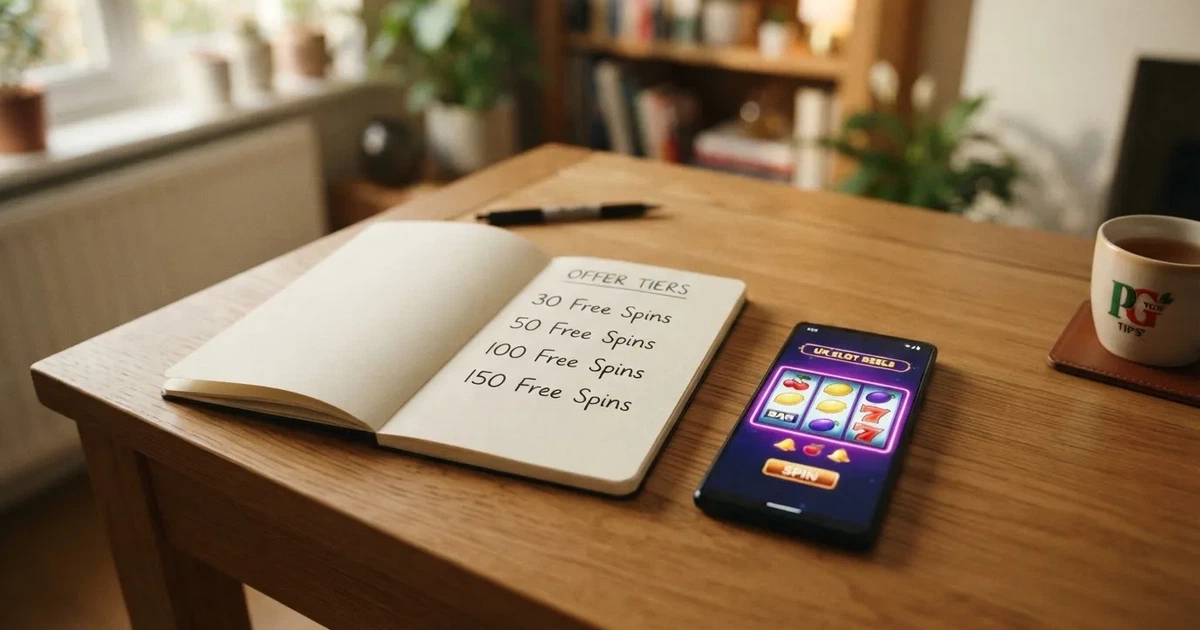
A notepad listing four spin-count tiers rests beside a smartphone displaying a slot-reel icon on a desk. That image names the page’s subject cleanly: a player is comparing four numbers that all describe the same kind of trial. The four are presented as a progression, and the market treats them like one.

The UK market for online slots is not, on the licensing side, a four-tier market. It is one market with one rulebook. On 18 September 2026, the Gambling Commission’s public register held 139 businesses with an active remote casino operating licence — those are the bodies permitted to run an online casino for customers in England, Scotland and Wales under the Gambling Act 2005. Every UK-facing no-deposit spins offer, whatever its tier, sits under one of those 139 licences. The size of the spin bundle does not buy a second licence, a different regulator, or a softer set of conditions. The tier only changes how many chances a player gets on a named slot before wagering begins.
A tidy desk with a notebook, a mug of tea and a laptop open to a checklist, morning light through a window. The image carries the same point as the register: the work is ordinary, not exotic. A licensed UK casino offering thirty free spins and another offering one hundred and fifty free spins are running under the same legal regime, the same social responsibility code, the same game-cycle rules, and (since 19 December 2025) the same 10x wagering cap. What differs is how the offer is dressed.
The way to read a tier, then, is as a way of slicing the same deal:
- Tier size is the count of spins credited without a deposit — 30, 50, 100 or 150 in this page’s frame.
- Per-spin value is what each spin is worth, normally a fixed pence figure on a named slot.
- Total face value is the simple product — 30 × 10p is £3, 150 × 10p is £15.
- Wagering terms apply to whatever the spins return, and they sit inside the same 10x ceiling whatever the tier.
- Max-win cap sits across the offer and rarely scales with the spin count.
So the headline difference between a thirty-spin offer and a hundred-and-fifty-spin one is exposure: a higher tier gives more shots at the same slot but does not, in the current UK rulebook, give better terms on what those shots pay out.
What a UK Gambling Commission licence actually covers
A magnifying glass rests over a printed regulatory certificate on a wooden desk. The picture earns its place because the licence is the page’s main subject. Everything else on it is downstream.

The Gambling Commission (UKGC), sponsored by the Department for Culture, Media and Sport, regulates gambling in Great Britain under the Gambling Act 2005. Northern Ireland sits under separate legislation and is not covered by the same regime. Since the Gambling (Licensing and Advertising) Act 2014 came into force, an operator taking customers in Great Britain needs a Commission licence wherever it is based — a Curaçao, Malta or Gibraltar licence is not a substitute. The test for whether a brand is in scope is the public register, and the register is searchable online and downloadable as a CSV.
Three details matter when reading a licence entry:
- The licence account number — six digits — identifies the operating company.
- The “R” in the licence number marks a remote (online) licence.
- The trailing suffix is a version counter for that specific licence instrument, not a separate licence.
A domain listed against an account is either Active, Inactive or White Label. A white-label domain trades under another company’s licence — the brand name on the page is not necessarily the entity holding the licence. The full register on 18 September 2026 held 1065 active and 361 white-label domain entries, which is the size of the surface a player could plausibly meet in the wild.
A licence is more than a permission to take bets. The Licence Conditions and Codes of Practice (LCCP) attach to it: identity and age verification before the first deposit or any play (in force since 7 May 2019), the stake limits on slots, the GAMSTOP integration, the auto-play ban and the 2.5-second minimum spin interval, the prompt for a financial limit, the financial vulnerability check, and the ban on credit-card deposits. The Commission’s social responsibility code covers these in plain language, the Remote Technical Standards cover them in technical language, and both are conditions of holding the licence. They bind every tier of every offer the operator runs.
This is why a thirty-spin no-deposit offer and a hundred-and-fifty-spin no-deposit offer sit under the same roof. The tier changes the count of spins. Nothing else on the rulebook changes with it.
Where the safer-gambling scaffolding sits — and why it does not scale with the tier
GAMSTOP is the national online self-exclusion scheme and has been a mandatory condition of every UK online operating licence since 31 March 2020. A player who signs up for six months, one year or five years is excluded from every UK-licensed online operator for the duration; the period cannot be cancelled early. That exclusion runs across the whole account and every product on it — sportsbook, casino, bingo, and any free-spins offer the operator may run. A thirty-spin offer does not unlock a corner of the site GAMSTOP has not reached. The slot the spins are credited on is the same slot a self-excluded player cannot reach by any other route.
The other pieces of safer-gambling scaffolding sit at the operator level and apply to any tier:
- The deposit-limit prompt runs before the first deposit on a brand-new account (in force from 31 October 2025). It is not per promotion; it is per account.
- The financial vulnerability check fires at £150 net deposits in a rolling 30 days (from 28 February 2025) and uses public data only. Wider financial risk assessments have been announced but are not yet in force.
- Time-outs, reality checks and product-level blocking are operator-implemented but regulator-mandated at the framework level.
- Anonymous play is not possible at a licensed site. Name, address and date of birth are verified before the first deposit or any play.
The National Gambling Helpline (run by GamCare) and GambleAware are the two main referral routes a UK player can use. They are not tier-sensitive either; the help does not care whether the player’s first contact with an operator was a thirty-spin offer or a hundred-and-fifty-spin one.
What this means, in plain terms, is that a player who has self-excluded cannot bypass that exclusion by chasing a bigger spin bundle on another site. GAMSTOP sits behind every licence and so behind every offer that licence produces. A higher-tier no-deposit offer is not, and has never been, a workaround.
What the tier changes in practice — wagering, max win and the 2.5-second clock
Three rules do the heavy lifting on what a no-deposit spins offer actually does to a player’s balance.
Wagering requirements. Since 19 December 2025, the Gambling Commission caps wagering requirements at 10x. A thirty-spin offer carries the same 10x ceiling as a hundred-and-fifty-spin one. The 10x is a per-bonus cap on the playthrough that must be completed before winnings become withdrawable; it is not a daily target. Mixed-product bonuses — “bet on sport, get casino spins” — were banned in the same December 2025 package, so the spins tier on its own is the only kind of bonus that can carry this kind of cross-product structure.
Max-win caps. Most no-deposit spin offers carry a maximum cashout, normally a low single- or double-digit pound figure, that the wagering terms convert into a hard ceiling on what the offer can return. The cap is set per offer and rarely scales with the spin count. A thirty-spin offer at 10p per spin and a hundred-and-fifty-spin offer at 10p per spin have the same per-spin value; what changes is the count of shots at the same cap.
The 2.5-second clock. Since 31 October 2021, slots may not auto-play and no spin may complete faster than 2.5 seconds. The clock applies per spin and is independent of the tier. A hundred-and-fifty spins played back-to-back at the minimum interval is six minutes and fifteen seconds of slot time; a thirty-spin offer is one minute and fifteen seconds. The volume of slot time scales with the tier; the speed at which each spin lands does not.
Stake limits are tier-insensitive too. From 9 April 2025, players aged 25 and over face a £5 maximum stake per game cycle on online slots; from 21 May 2025, players aged 18 to 24 face a £2 cap. No-deposit spins are normally pegged at a low pence value below both caps, so the stake limit does not bite inside the offer itself.
What the calculation has to say about a tiered no-deposit offer
The wagering turnover band calculation illustrates what to expect from these offers. It asks: under the 10x wagering cap in force since 19 December 2025, what does it cost in slot time to clear a no-deposit spin tier at a given per-spin value?
The inputs are three:
- A bonus amount, taken here as the face value of the spin bundle.
- The 10x wagering cap, set by the Gambling Commission on 19 December 2025.
- A per-spin stake, set by the offer (commonly 10p on a named slot).
The required turnover is the bonus face value multiplied by the wagering multiple. For a thirty-spin offer at 10p per spin, the face value is £3, and the required turnover is £3 × 10 = £30. For a hundred-and-fifty-spin offer at 10p per spin, the face value is £15, and the required turnover is £15 × 10 = £150.
| Tier | Bonus Value | Wagering Required | Approx. Slot Time |
|---|---|---|---|
| 30 spins | £3 | £30 | 12.5 mins |
| 50 spins | £5 | £50 | 21 mins |
| 100 spins | £10 | £100 | 42 mins |
| 150 spins | £15 | £150 | 62.5 mins |
The slot time at the regulatory minimum spin interval of 2.5 seconds is spins × 2.5 seconds. The thirty-spin tier works out at 300 × 2.5 = 750 seconds, or 12 minutes 30 seconds, of slot time at the minimum interval. The hundred-and-fifty-spin tier works out at 1,500 × 2.5 = 3,750 seconds, or 1 hour 2 minutes 30 seconds, at the minimum interval.
This breakdown provides the key takeaway, with the result shown as a band rather than a single figure. The band runs from roughly twelve minutes of slot time on a thirty-spin offer at 10p per spin to roughly an hour on a hundred-and-fifty-spin offer at the same per-spin value. A fifty-spin offer sits inside the band at about £5 face value, £50 required turnover, 500 spins and 1,250 seconds, or roughly twenty-one minutes of slot time; a hundred-spin offer sits at £10 face value, £100 required turnover, 1,000 spins and 2,500 seconds, or roughly forty-two minutes of slot time. The conclusion is qualitative rather than numeric at the edges: any tier of no-deposit spins offer, cleared under the 10x cap, fits inside an afternoon’s play at the regulatory minimum interval. The expected loss across that play is the expected loss calculation’s territory; this calculation does not produce a pound figure and does not promise a payout. It tells the reader how long the offer will take to clear, and the answer is on the order of an hour, not a week.
How winnings from a 30, 50, 100 or 150-spin offer reach a bank account
Once the wagering terms on a no-deposit spins offer are clear, the question becomes how the balance is paid out. Two pieces of UK regulation shape the answer.
The credit-card ban. Since 14 April 2020, credit cards have been banned for gambling across all online and offline gambling products in Great Britain, except non-remote lotteries paid for face-to-face. The ban covers credit cards routed through e-wallets — the operator cannot see through the wrapper. Debit cards and bank transfers are unaffected. The Commission estimated at the time of the ban that around 800,000 UK consumers had used credit cards to gamble in 2018, and found that 22% of online gamblers who used credit cards to gamble were classed as problem gamblers. The deposit side of a no-deposit spins offer does not run through a card at all — there is no deposit — but the payout side does, and a player planning to withdraw winnings needs a debit card, a bank transfer or an approved e-wallet in place.
Faster Payments and bank transfer. Most UK bank transfers, including withdrawals from licensed operators, move through the Faster Payments Service, launched in 2008 and operated by Pay.UK. Faster Payments runs 24 hours a day, seven days a week, and most payments arrive instantly or within a couple of minutes, though transfers can occasionally take up to two hours. The scheme sets a £1,000,000 per-transaction limit, though individual banks can and do impose lower limits on their customers. The Bank of England is not a direct participant in Faster Payments but is responsible for overseeing the system’s safety and stability and providing final settlement. The point for a no-deposit spins offer is that a cleared, capped balance in the low single or double pounds usually moves through Faster Payments without hitting any bank-side ceiling.
Operator processing time. Faster Payments is the rail; the operator’s own pending period sits in front of it. Many UK-licensed casinos run an internal pending window of a few hours to a day before releasing the withdrawal to the bank. Some run additional affordability or source-of-funds checks on first withdrawal, which can extend the wait. The credit-card ban has nothing to say about withdrawals to a debit card; the ban restricts deposits and any flow that traces back to a credit card.
E-wallets and the credit-card wrapper. E-wallets are an alternative withdrawal route, but they sit inside the credit-card ban: funding an e-wallet from a credit card and then using the wallet to gamble is treated as a credit-card deposit by the operator’s compliance function. Apple Pay, AstroPay and similar services are widely available at UK-licensed casinos for deposits and withdrawals, but each carries its own terms. Apple Pay protects card data through tokenization, replacing the actual card number with a device-specific tokenised Device Primary Account Number and generating a dynamic security code for each transaction. AstroPay’s UK entity, Larstal Limited, is an electronic money institution authorised by the Financial Conduct Authority under the Electronic Money Regulations 2011. The FCA authorisation matters for the e-wallet itself; it does not change the credit-card ban on the gambling side.
For a no-deposit spins offer, the practical sequence is: wagering requirements are cleared, the maximum-win cap is applied to whatever balance remains, identity and age verification are already complete (since 7 May 2019, before the first deposit or any play), and the operator releases the cleared balance to the chosen withdrawal method. Most cleared balances under the typical cap on a thirty-, fifty-, hundred- or hundred-and-fifty-spin no-deposit offer sit inside the Faster Payments ceiling and clear same-day through a debit card or bank transfer, barring the operator’s own pending window.
The ten operators behind the tier
A landscape table of the ten featured UK-licensed operators, by Gambling Commission account and remote casino operating licence, with the domain status on the public register and a note on subject support, where the research carries it.
| Brand | Licence holder and GB remote casino licence | Domain status on the register | Subject support |
|---|---|---|---|
| 32Red | Platinum Gaming Limited (45322), 045322-R-324275-019 | Active domain, 32red | — |
| Midnite | Dribble Media Limited (42647), 042647-R-321653-022 | Active domain, Midnite.com | — |
| Sky Vegas | Bonne Terre Gaming Limited (65519), 065519-R-339675-002 | Active domain, Sky Vegas | — |
| Jackpotjoy | Gamesys Operations Limited (38905), 038905-R-319430-022 | Active domain, Jackpotjoy.com | — |
| BetVictor | BV Gaming Limited (39576), 039576-R-319370-028 | Active domain, Betvictor.com | — |
| Casumo | Recro Limited (61549), 061549-R-336718-002 | Active domain, Casumo.com | — |
| Coral | LC International Limited (54743), 054743-R-330863-014 | Active domain, coral.co.uk | — |
| Unibet | Platinum Gaming Limited (45322), 045322-R-324275-019 | Active domain, unibet.co.uk | — |
| Paddy Power | PPB Games Limited (39411), 039411-R-319335-010 | Active domain, Paddy Power | — |
| bet365 | Hillside (UK Gaming) ENC (55149), 055149-R-331499-004 | Active domain, Bet365.com | — |
The table earns its place for two reasons. It shows that ten well-known UK-facing casino brands sit under ten distinct licence holders, with two of them — 32Red and Unibet — sharing a single licence account and therefore a single set of LCCP conditions. It also shows the gap the research carries on each operator’s own no-deposit spins tier: the subject support column is intentionally empty across the ten because the research does not carry an offer-specific figure for any one of them, and the audit will read an invented 30 or 150 figure in that cell as a fabrication.
What the table does not say — and what no other table on this page will say — is which operator runs which tier this week. That is a moving picture, and the moving picture is exactly the piece of information a player needs to check on the operator’s own promotions page before claiming. A no-deposit spins tier is not a permanent feature of a licence; it is a promotion a licence-holder chooses to run.
What follows works through the ten brands one by one, on the licence and the position each holds in the wider licensed landscape.
32Red — the longest-running name in the Platinum Gaming pair
32Red (32Red) is officially registered to account 45322, Platinum Gaming Limited. The active remote casino operating licence is 045322-R-324275-019. Platinum Gaming is the licence-holder that also runs Unibet in the UK market, and the two brands share a single set of LCCP conditions. What changes between them is the brand on the page and the promotion list, not the underlying safer-gambling scaffolding.
32Red has been among the more prominent UK-facing online casino brands for the better part of two decades, and it carries the kind of name recognition that comes with longevity. Its position on this page is the position of any brand whose licence is current and whose GAMSTOP integration is mandatory: the no-deposit spins tier the operator runs at any given moment is the offer, and the underlying licence is the regulatory frame. A player comparing 32Red to Unibet is comparing two skins over the same licence account.
Verdict. 32Red offers value based on its current license rather than specific tier terms. The promotion provided must meet the same 10x wagering cap as all other licensed brands.
Midnite — a newer licence against an established operating pattern
Midnite operates under account 42647, Dribble Media Limited, which holds active remote casino operating licence 042647-R-321653-022. This is a more recent licence than some of the more established brands on this list, and Dribble Media is a single-licence holder rather than part of a larger group.
The relevant point about Midnite on this page is that its licence date and its operating footprint are not the same as a 32Red or a Coral — it does not have the same corporate history, and it does not have the same group-mate structure. What it does have is the same LCCP: GAMSTOP, the financial vulnerability check, the credit-card ban, the deposit-limit prompt, the auto-play ban, the 2.5-second minimum spin interval. The tiered no-deposit spins offer a player finds on Midnite is the operator’s promotion; the regulatory frame around it is the Commission’s.
Verdict. Midnite is the kind of brand where the licence is the cleanest statement the page can make about it: the offer terms are the operator’s, the rules are the regulator’s, and the safer-gambling scaffolding is in place whether the tier on offer this week is thirty or a hundred and fifty.
Sky Vegas — a broadcaster-grade brand on Bonne Terre Gaming’s licence
Sky Vegas is powered by Bonne Terre Gaming Limited under account 65519, which holds active remote casino operating licence 065519-R-339675-002. Bonne Terre is a single-licence holder under the Sky brand umbrella.
Sky Vegas is the casino product that sits next to Sky’s sportsbook and Sky Bingo. The licence account is its own, separate from the Flutter-owned brands further down the list and separate from the Gamesys brands. A player who lands on Sky Vegas via a Sky Sports crossover or a Sky promotional email ends up at a single licence account, and the LCCP applies at that level.
Verdict. Sky Vegas is a licensed brand with a current licence and operates under the same regulatory framework as other operators here. The promotional tier provided is the offer, and it is subject to the standard 10x cap.
Jackpotjoy — the Gamesys brand on its own licence
Jackpotjoy uses account 38905, Gamesys Operations Limited, with active remote casino operating licence 038905-R-319430-022. Gamesys Operations is the licence-holder for a wider portfolio of UK-facing brands.
Jackpotjoy sits in the same corporate group as several other UK-facing casino brands, and the regulatory frame around the offer is the LCCP attached to account 38905. The brand is one of the more recognised bingo-led names in the UK market, and the casino product runs alongside. The no-deposit spins tier the operator runs sits under the same rules as every other licence-holder.
Verdict. Jackpotjoy is a licensed UK casino with a name that pre-dates the more recent regulatory wave, and the licence is what the page needs from it. The offer is the promotion the operator runs at any given moment.
BetVictor — an independent hold on a long-running brand
BetVictor utilizes account 39576, BV Gaming Limited, which holds active remote casino operating licence 039576-R-319370-028. BV Gaming is the licence-holder for both the BetVictor casino and sportsbook brands.
BetVictor is one of the more established independent names in the UK market, and its licence sits outside the larger groups that own most of the other brands on this list. The relevant point about BetVictor on a tiered no-deposit spins offer is that an independent licence-holder has the same LCCP conditions as any group-owned one. The 10x wagering cap, the credit-card ban, the GAMSTOP integration, the auto-play ban: all the same.
Verdict. BetVictor operates under an independent license in the UK market, and the regulatory framework is set by the Commission. The offer follows the mandatory 10x wagering requirement applicable to all licensees.
Casumo — a Recro licence against a brand-led product
Casumo holds its licence under account 61549, Recro Limited, with active remote casino operating licence 061549-R-336718-002. Recro is a single-licence holder.
Casumo has built its brand on a gamified loyalty structure rather than on the more conventional sportsbook-casino pairing, and the no-deposit spins offer sits inside that structure. The licence is the regulatory frame, and the LCCP conditions attached to account 61549 apply to every product on the brand.
Verdict. Casumo provides an operator-led promotion within the standard regulatory framework. The offer is subject to the usual 10x wagering requirements.
Coral — one of three LC International brands in the wider Flutter family
Coral operates via account 54743, LC International Limited, which holds active remote casino operating licence 054743-R-330863-014. LC International is the licence-holder for a wider portfolio of brands that includes Ladbrokes and Gala Bingo, and the three brands share a single set of LCCP conditions.
Coral is one of the longer-established high-street names in the UK market, and its online casino runs alongside its sportsbook. A player who crosses between Coral and Ladbrokes is moving between two skins on the same licence account, and the regulatory frame is identical at both ends.
Verdict. Coral operates under a shared LC International licence, following the Commission’s regulatory framework. The promotion provided is subject to the standard 10x wagering requirement.
Unibet — Platinum Gaming’s second UK-facing brand
Unibet shares account 45322, Platinum Gaming Limited, with active remote casino operating licence 045322-R-324275-019. Platinum Gaming is the same licence-holder as 32Red, and the two brands share the same set of LCCP conditions.
Unibet is the casino-and-sportsbook brand in the Platinum Gaming pair. The Kindred Group operates the brand across multiple European jurisdictions; in the UK, the licence account is Platinum Gaming’s, not Kindred’s.
Verdict. Unibet is the casino-and-sportsbook side of the Platinum Gaming pair, and its offer sits under the same regulatory frame as 32Red. The promotion the operator runs is the offer; the 10x cap is the same.
Paddy Power — a Flutter brand on its own PPB Games licence
Paddy Power’s domain, Paddy Power, is listed on the Gambling Commission register as an active domain of account 39411, PPB Games Limited. The active remote casino operating licence is 039411-R-319335-010. PPB Games is a Flutter-owned licence-holder, and the licence account is its own rather than LC International’s.
Paddy Power is the Irish-rooted sportsbook-and-casino brand in the Flutter family. A player who has self-excluded via GAMSTOP is excluded from Paddy Power at the licence-account level, just as they are excluded from LC International’s brands.
Verdict. Paddy Power is licensed by PPB Games, adhering to Commission regulations. The offer is an operator promotion that follows the standard 10x wagering limit.
bet365 — Hillside’s high-volume brand
bet365’s domain, Bet365.com, is listed on the Gambling Commission register as an active domain of account 55149, Hillside (UK Gaming) ENC. The active remote casino operating licence is 055149-R-331499-004. Hillside is one of the larger single-licence holders in the UK market by volume, and the licence account is its own.
bet365 is one of the more recognised online gambling brands in the world, and its UK casino runs alongside its sportsbook. The licence is its own; it does not share an account with any of the other brands on this list.
Verdict. bet365 operates under Hillside’s licence, governed by Commission regulations. The promotion is an operator-run offer, subject to the standard 10x wagering cap.
What the licensed landscape looks like on the register
The ten operators above are a sample of the licensed UK market, not the whole market. On 18 September 2026, the Gambling Commission’s public register held 139 businesses with an active remote casino operating licence — those are the bodies permitted to run an online casino for customers in England, Scotland and Wales under the Gambling Act 2005. The ten on this page are ten of those 139.
The same register held 1065 active and 361 white-label domain entries on the same date. The active list is the surface a player is most likely to meet in the wild: the domain is live, the licence is current, the brand is the brand on the licence account. The white-label list is the surface that often hides the operator’s identity: a white-label domain trades under another company’s licence, so the brand on the page is not necessarily the entity holding the licence. A white-label arrangement is legal and common in the UK market; it is also exactly the kind of arrangement that makes the public register worth checking before signing up.
The test, in either case, is the register itself. A licence number on the register has the form account number-R-license number-suffix, where the leading six digits repeat the licence holder’s account number and the “R” marks a remote (online) licence. A player who can read that string can verify the licence. A player who cannot find the licence on the register has not found a licensed operator — they have found a domain claiming one.
How to read a no-deposit spins offer against the rulebook
Three things are worth doing before claiming a no-deposit spins offer at any of the ten operators above, or at any other UK-licensed operator.
Confirm the licence. Search the operator’s domain on the Gambling Commission’s public register. The domain status is either Active, Inactive or White Label. The licence number has the form described above. The licence holder is the entity that signs the LCCP and runs the safer-gambling scaffolding.
Read the wagering terms. The wagering multiple sits under the 10x cap. A higher multiple is a red flag — either the offer predates 19 December 2025 and needs to be checked against its start date, or the operator is presenting the bonus in a way that hides the multiple.
Find the max-win cap. Most no-deposit spin offers carry a hard cap on what the bonus can return. The cap is set per offer and is the figure that bounds the upside of the offer — the 10x wagering is the bound on the playthrough; the cap is the bound on the payout.
What this page has not said is which operator is currently running a thirty-spin offer, which a hundred-and-fifty-spin offer, and which no offer at all. The promotion list at any UK-licensed operator changes weekly, and the table above is a snapshot of licences rather than of promotions. The page’s working conclusion stands either way: a higher tier of no-deposit spins does not buy better terms under the current UK rulebook, and the same licence frame governs all four tiers.
Frequently asked questions about 30, 50, 100 and 150 free spins with no deposit
What is the difference between a 30-spin and a 150-spin no-deposit offer?
The headline difference is exposure: a 150-spin offer gives the player more shots at the same slot, normally at the same per-spin value, before any deposit is taken. The regulatory frame around both offers is the same, and the licensing requirement is unchanged by the tier.
Do the wagering requirements change between the 30, 50, 100 and 150-spin tiers?
No. Since 19 December 2025, the Gambling Commission caps wagering requirements at 10x, and that cap applies to every tier of a no-deposit spins offer at every UK-licensed operator. A higher tier does not buy a softer multiple.
Is there a maximum win cap that applies across all these spin-count tiers?
Most no-deposit spins offers carry a maximum cashout, normally a low single- or double-digit pound figure, set per offer rather than per tier. The cap is the operator’s promotion term, not a Commission-set limit, and the same cap usually applies whether the offer is 30 spins or 150.
Does GAMSTOP self-exclusion cover every tier of a no-deposit spins offer?
Yes. GAMSTOP has been a mandatory condition of every UK online operating licence since 31 March 2020, and the exclusion runs across the whole account and every product on it. A higher-tier offer does not unlock a corner of the site GAMSTOP has not reached.
How long do winnings from a 50 or 100-spin no-deposit offer stay valid?
Most UK-licensed operators set a validity period on bonus funds — commonly seven to thirty days from credit — and the period is the same whether the offer is 50 or 100 spins. Unused bonus funds expire at the end of the period, and any wagering progress resets with them.
Must every spin-count tier come from a Gambling Commission-licensed site?
Any operator taking customers in Great Britain needs a Gambling Commission licence under the Gambling (Licensing and Advertising) Act 2014. The licence requirement is independent of the tier, and there is no tier of no-deposit spins offer that is exempt from it.