
Low wagering casino bonuses on UK-licensed sites: how the 10x cap reshapes the picture
A wagering requirement is the multiplier a casino puts on a bonus before you can withdraw it. A 10x requirement means a £100 bonus must be turned over ten times — £1,000 of qualifying play — before any winnings tied to it become cash. Until recently the multiple was a marketing choice left to the operator. From 19 December 2025 it is not. The Gambling Commission capped wagering at 10x on every deposit bonus offered by a GB-licensed casino, and the change has moved the goalposts for what counts as a “low wagering” offer at all. The bonus that was once the headline — 30x, 40x, sometimes 65x — is now off the table for any licensed operator. The bonus worth chasing is the one that treats 10x as the ceiling and works within it.
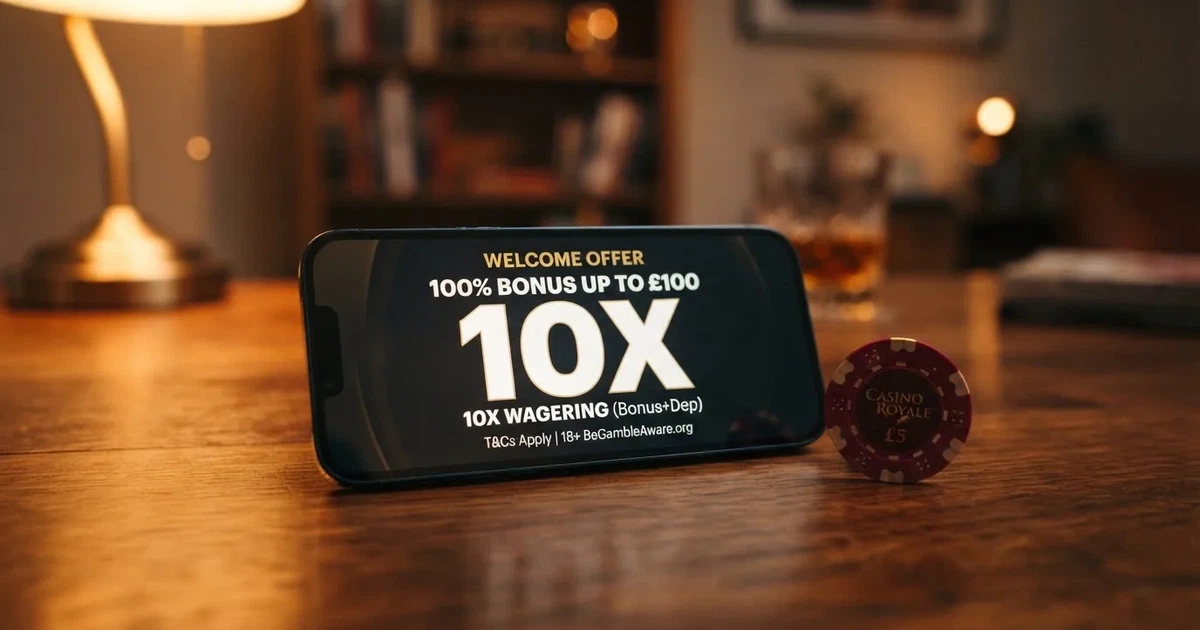
The page that follows is built for someone comparing those offers. Ten operators from the Gambling Commission’s public register sit below in their own block, each one named, each one described against the same benchmark. The arithmetic the cap forces is worked through in plain prose, not formulas. The licensed landscape is sketched, the safer-gambling rules that travel with any of these bonuses are laid out, and the deposit and withdrawal mechanics a low wagering offer depends on are covered in their own shelf. A short FAQ closes the page. Currency is pounds sterling throughout; spellings follow British English.
Current as of 7 November 2026, verified against the Gambling Commission’s public register of gambling businesses.
Table of Contents
- The UK online casino landscape in 2026
- What holding a Gambling Commission licence obliges an operator to do
- Safer-gambling protections around any bonus, low wagering or not
- Deposits, withdrawals and the mechanics behind a low wagering bonus
- What a low wagering bonus actually is, now the cap sits at 10x
- How a low wagering bonus is structured in practice
- What offshore means, and why it is on the page
- The ten operators, side by side
- MrQ
- bet365
- PokerStars
- Paddy Power
- Betfair
- William Hill
- BetVictor
- Sky Vegas
- Virgin Games
- Gala Bingo
- How the ten compare, and where the choice actually sits
- Frequently asked questions
The UK online casino landscape in 2026
The Commission’s public register is the test for whether a brand is licensed. On 18 September 2026 it listed 139 businesses holding an active remote casino operating licence, and the matching domain register held 1,065 active and 361 white-label website entries — meaning 1,426 consumer-facing sites mapped back to those 139 licence accounts. A white-label site trades under another company’s licence: the brand on the page is not the licence holder, but the licence is real and the consumer protections travel with it.
What the register tells a reader is structural rather than commercial. It does not rank bonuses, does not endorse offers, and does not check wagering terms. It confirms that the operator has passed the Commission’s checks on financial probity, social responsibility and the technical standards the LCCP sets, and that the brand is accountable to a UK regulator a player can complain to. That accountability is what makes the rest of this page possible. Every block below assumes the operator is on this register. Every figure is read through that filter.
The 139-licence picture is a snapshot. New licence applications are decided through the year; existing licences are reviewed against the LCCP and the Commission’s remote technical standards; domains are added and removed. The figures are current against the register as it stood on 18 September 2026, and they are checked against the same source on the date stamped at the top of this page.
| Register entry | Count on 18 September 2026 |
|---|---|
| Active remote casino operating licences | 139 |
| Active domains | 1,065 |
| White-label domains | 361 |
| Total consumer-facing sites | 1,426 |
What holding a Gambling Commission licence obliges an operator to do
The Gambling Commission is sponsored by the Department for Culture, Media and Sport and operates under the Gambling Act 2005, which covers Great Britain — England, Scotland and Wales, not Northern Ireland. The 2014 Act closed a route that once let an operator based offshore take British customers on a home licence; from that point any operator taking GB customers needs a Commission licence wherever it sits. A Curaçao, Maltese or Gibraltar licence is not a substitute. The Commission’s public register is the whole test, and the way to read it is the licence number itself.

A remote casino licence number on the register has the form Account-R-Number-Suffix. The leading six digits repeat the licence holder’s account number; the “R” marks a remote (online) licence; the suffix distinguishes separate licences for the same account. So 060629-R-337532-004 reads as: account 60629, remote, licence 337532, the fourth issued to that account. Each operator entry in this page carries that string, and it can be looked up directly on the register.
What the licence obliges is set out in the LCCP and the social responsibility code, and the obligations have tightened across the last five years. ID checks — name, address and date of birth — are mandatory before a first deposit and before any play, and have been since 7 May 2019. Credit cards have been banned for gambling since 14 April 2020, including credit cards routed through e-wallets. Auto-play has been banned since 31 October 2021; a slot spin cannot be faster than 2.5 seconds; losses that look like wins — a return bigger than the stake on a losing round — have been banned in the same package. Online slots carry a maximum stake per game cycle: £5 for players aged 25 and over from 9 April 2025, and £2 for 18-24 from 21 May 2025. There is no state-set deposit or loss ceiling, but every licensed operator must now prompt a customer to set a financial limit before the first deposit, a rule that took effect from 31 October 2025.
The 10x cap on wagering landed on 19 December 2025 and the same rule closed mixed-product bonuses — a free bet on sport bundled with casino spins — for the same reason. Those rules are not the operator’s preference. They are the licence condition.
Safer-gambling protections around any bonus, low wagering or not
Every bonus on a GB-licensed site travels with a package of protections the operator cannot opt out of. They are not features to be marketed. They are the licence condition.
GAMSTOP is the national online self-exclusion scheme, mandatory for every online licence since 31 March 2020. A self-exclusion is set for six months, one year or five years and cannot be cancelled early. The register holds the exclusion against the player’s name and address and date of birth; every licensed operator checks it before allowing play. There is no GAMSTOP-free route at a licensed casino. The point of the scheme is that one exclusion covers every site, not just the brand the player happens to be on at the moment.
The 18-and-over rule is policed at sign-up, not at withdrawal. ID checks run before the first deposit and before any play; the check covers name, address and date of birth. Anonymous play is not possible at a licensed site. The minimum age is 18.
Financial vulnerability checks sit alongside the ID check. From 28 February 2025 a light-touch check runs at £150 of net deposits in a rolling 30 days, using publicly available data only — credit history is not pulled. Wider financial risk assessments have been signalled by the Commission but are not yet in force. The £150 trigger is the current test; the operator is the one who runs it, but the licence requires it.
Slot stake limits apply to the bonus in the same way they apply to cash play. The £5 per game cycle for 25-plus and £2 for 18-24 are stake limits, not bonus caps, and they bite hardest on a player who would have staked higher in a clear-the-bonus session. A £5 stake on a 10x turnover of £1,000 is 200 spins; a £2 stake is 500 spins. The licence condition is the same on both; the time the bonus takes to clear is not.
Reality checks — pop-ups showing session length and net position — interrupt play at fixed intervals on every licensed site. The interval is set by the operator within the Commission’s standards. Time-outs, a shorter exclusion set on the brand rather than through GAMSTOP, sit alongside.
Help lines sit behind the licence. GamCare runs the National Gambling Helpline; GambleAware funds treatment and education. The two are signposted on every licensed operator’s safer-gambling page. They are not features. They are part of the licence.
Deposits, withdrawals and the mechanics behind a low wagering bonus
A deposit bonus is gated by a deposit, which means the player must put money into the account before the bonus unlocks. The mechanics on either side of that deposit matter because the bonus is only as good as the cashout at the end of it.
Deposits at a GB-licensed site run through debit cards and bank transfers. Credit cards have been banned for gambling since 14 April 2020. E-wallets are permitted provided the funding source is a debit card or bank account — credit-funded e-wallet balances are out. The 14 April 2020 ban was estimated by the Commission to have affected around 800,000 UK consumers who used credit cards to gamble in 2018; the same analysis classed 22% of online gamblers who used credit cards to gamble as problem gamblers. The ban is the regulatory response to those figures.
Bank transfers within the UK typically move through the Faster Payments Service, launched in 2008 and operated by Pay.UK. The scheme runs 24 hours a day, seven days a week, and most payments arrive instantly or within a couple of minutes; the worst case is two hours. The Bank of England is not a direct participant in Faster Payments, but it oversees the system’s safety and stability and provides final settlement. The scheme sets a £1,000,000 per-transaction limit; individual banks can and do impose lower limits on their customers, and a casino deposit rarely bumps against any of them.
Apple Pay is one wallet route a GB-licensed casino can accept, provided the underlying funding is a debit card or a bank account. Apple Pay was launched on 20 October 2014, initially supporting US-issued cards only; UK-issued cards joined on 14 July 2015. Card data is protected through tokenisation — the actual number is replaced by a device-specific Device Primary Account Number, and each transaction generates a dynamic security code. In-store payments use NFC against a contactless terminal; in-app and web payments authenticate with biometrics. Apple states that a supported card from a participating card issuer is required, and that Apple Pay is not available in all markets.
AstroPay is a second wallet route, where the operator chooses to support it. AstroPay was founded in 2009 and is headquartered in Uruguay. It operates as a global digital wallet offering online payments, virtual and physical debit cards, and peer-to-peer transfers. Its UK entity, Larstal Limited, is an electronic money institution authorised by the Financial Conduct Authority under the Electronic Money Regulations 2011; its Isle of Man entity, AstroPay Global (IOM) Limited, is licensed by the Isle of Man Financial Services Authority for money transmission. AstroPay serves users across markets including Argentina, Australia, Brazil, Canada, Colombia, Denmark, Spain, the United Kingdom, the United States and Uruguay. A casino that accepts AstroPay takes it through one of those entities, and a UK player funding a deposit through it is funding it through Larstal Limited.
Withdrawals on a GB-licensed site run through the same rails, in reverse, and the speed depends on the rail chosen. A debit card withdrawal takes longer than a debit card deposit because the operator and the card issuer both run checks; a bank transfer through Faster Payments typically clears the same day once the operator releases it; an e-wallet withdrawal is usually the fastest. A low wagering bonus interacts with withdrawal speed only at the cashout step — once the bonus has cleared and any winnings tied to it have been moved to the cash balance, the rail is the rail.
There is no player tax on gambling winnings in the UK. The duty sits on the operator. Remote Gaming Duty was raised from 21% to 40% from 1 April 2026; the figure is the operator’s cost and is not deducted from a winning. The Commission does not tax the player, and neither does HMRC.
What a low wagering bonus actually is, now the cap sits at 10x
A “low wagering” bonus used to mean something below the market average. The market average was high — 35x, 40x, 65x on some slots-led welcome packages — so a 20x offer was the headline. From 19 December 2025 the cap is 10x. Anything above it is not legal on a GB-licensed site, so the average has been compressed downwards. A 10x offer is now the ceiling, not the floor.
A low wagering bonus, in the present market, is one that approaches the 10x cap from below. A 5x offer is genuinely low. A 10x offer is the legal maximum and is now common across welcome packages. A 1x or no wagering offer exists at some brands and is genuinely a different product; the bonus is treated as cash from the moment it lands, and any winnings tied to it are withdrawable without further play.
The arithmetic a wagering requirement forces is the same shape whichever multiple sits on it. A £100 bonus at 10x is £1,000 of qualifying play. At a £5 slot stake that is 200 spins; at a £2 slot stake that is 500 spins. The £5 stake is the upper limit for a 25-and-over player; the £2 stake is the upper limit for an 18-24 player. The bonus does not change, but the slot stake cap changes the time it takes to clear. The qualification rule — what counts toward the £1,000 turnover — varies by operator and by game. Slots typically contribute 100%; table games often contribute less; some games are excluded entirely. The terms page is where this lives, and the difference between a 100% and a 50% contribution rate halves the effective turnover.
The cap on stakes that the licence sets, and the cap on wagering that the same rule set, sit on top of each other. The stake cap protects the player per spin. The wagering cap protects the player across the bonus. The two are not the same rule, but they run together. A £5-spin player turning over £1,000 takes 200 spins at the cap; a £2-spin player takes 500. Both are inside the 10x wagering ceiling. Both meet the stake limit the licence sets.
No-deposit bonuses carry the same shape of requirement, but the figure on it is usually lower because there is no deposit backing it. A £10 no-deposit bonus at 10x is £100 of qualifying play — small in absolute terms but higher as a multiple of the bonus than a deposit bonus looks. The terms attached to a no-deposit bonus are tighter: a max-cashout cap, a game list, a shorter expiry. The same 10x rule applies, but the rule is not the only restriction. A no-deposit bonus that looks generous can be small once the cashout cap is read.
Worked example: what a 10x turnover looks like in time and cost
Take a £100 deposit bonus at 10x. Turnover is £1,000. At a £5 slot stake — the limit for a 25-and-over player — that is 200 spins. A slot spin on a UK-licensed site takes at least 2.5 seconds under the auto-play ban, so 200 spins is at least 500 seconds, or about eight minutes of continuous play. At a £2 stake — the limit for an 18-24 player — that is 500 spins, about 21 minutes. Both figures are floor estimates: real sessions are longer because players vary their stake, switch games, and pause. The eight-minute figure is the time on the trigger; it is not the time the bonus takes to clear in practice.
The expected loss on a £1,000 turnover depends on the RTP of the game played through. A 96% RTP slot returns £960 on £1,000 of qualifying play, which means an expected loss of £40 on the bonus alone — before any winnings tied to it. A 94% slot returns £940, an expected loss of £60. The bonus is being paid for in real money across the clearing period, and the price is the gap between 100% and the game’s RTP. A player who plays a 96% slot is paying £40 to clear a £100 bonus. A player who plays a 94% slot is paying £60. The same wagering requirement, the same turnover, two different costs.
The 10x cap reduces the multiplier but does not change the shape of the calculation. A bonus at 30x on a 96% slot costs £120 in expected loss to clear on a £100 bonus. The 10x cap moves that figure down to £40. The cap is a real reduction in the cost of accepting a bonus, and that is what makes a 10x offer the natural target in the present market. A no-wagering bonus, by contrast, costs the player only the time it takes to play through any qualification tied to it — and that is a different product altogether.
The calculation above holds on one assumption: only the bonus amount is wagered. A player who funds the bonus with cash and plays through both balances at once pays the same per-spin but spreads the expected loss across a larger turnover. The result is a smaller gap per pound, but the same total cost per spin. The arithmetic belongs to the bonus; the per-spin cost belongs to the game.
How a low wagering bonus is structured in practice
A welcome package is the most common shape. A deposit unlocks a matched bonus — 100% on a first deposit of £10 or more is typical — and the bonus carries the wagering requirement, the contribution table and the expiry. The expiry is usually seven to thirty days; a longer expiry is the operator absorbing more risk and is, in marketing terms, the most generous version of an otherwise ordinary package. A seven-day expiry is the floor. Anything shorter is not an offer worth taking.
Free spins sit on top of or inside the welcome package. The shape of free spins has moved with the bonus cap. A free-spin bundle used to carry its own wagering on the winnings; the 10x cap means the multiplier cannot be set above 10x, and most licensed operators now run free spins either as no-wagering or at the lowest legal multiple. The bundle is a marketing feature; the wagering on it is the legal ceiling.
Reload bonuses — a bonus on a second or third deposit — run the same shape as a welcome offer, with a lower headline multiple and a smaller percentage match. A 50% reload at 10x is the ordinary shape. No-deposit bonuses are rarer on the regulated side than the offshore side, because the Commission’s stricter rules reduce the operator’s appetite for them; where they exist, they are small (£5 to £20), tight on cashout, and short on expiry.
Loyalty and VIP bonuses run on the same mechanics with a different marketing wrapper. A weekly reload at 10x for a high-volume player is the same arithmetic as a welcome offer, scaled by the player’s deposit. The brand difference is in the offer’s terms, not in its structure.
What the offer does not cover
The 10x cap covers the wagering requirement. It does not cover the max-cashout cap, the game list, the contribution table or the expiry. A no-deposit bonus at 10x with a £50 max cashout is a different offer from a no-deposit bonus at 10x with a £200 max cashout, and the difference is on a page the casino does not market. The headline number is the multiplier. The terms page is the offer.
The mixed-product bonus ban — same rule package as the 10x cap — closed one more route. A free bet on sport bundled with casino spins is no longer legal on a GB-licensed site. The bundle was a marketing feature on multi-product brands; the ban removed it. The 10x cap and the mixed-product ban are the two halves of one rule change.
What offshore means, and why it is on the page
The bonus landscape on the offshore side is wider. A Curaçao-licensed operator can offer 35x, 50x, or a no-deposit bonus with a £500 max cashout, because it is not subject to the Commission’s rules. The price of that offer is the protection a GB licence buys. An offshore site does not run GAMSTOP; it does not run the £150 financial vulnerability check; it does not enforce the stake limit; it does not pass complaints to an ADR approved by the Commission; the player has no Commission complaints route. Providing gambling to people in Great Britain without a licence is an offence under section 33 of the Gambling Act 2005. The Commission disrupts illegal sites — cease-and-desist notices, search-engine delisting, payment and hosting referrals — but has no ISP-blocking power. The penalty is on the operator, not the player. What the player loses on an unlicensed site is protection.
A GB-licensed operator can offer a smaller bonus on tighter terms. The trade is not free. The £5 stake cap slows the clearing. The 10x wagering cap reduces the multiplier but does not remove it. The ID check delays the first session. The GAMSTOP link means a self-excluded player cannot open an account. The financial vulnerability check interrupts play at the £150 rolling deposit threshold. Each of those is a feature of the licence, and each of them is a friction an offshore operator does not impose. The reason to pay that friction is that the alternative is no friction and no recourse.
The ten operators, side by side
Every brand in the table below is taken from the Gambling Commission’s public register on 18 September 2026. The licence holder is the entity that holds the remote casino licence; the GB remote casino licence is the licence number on the register; the domain status reflects how the brand’s site is recorded against the licence account. Where a brand is listed as a white-label domain, it trades under another company’s licence — the brand on the page is not the licence holder, but the licence is real.
| Brand | Licence holder | GB remote casino licence | Domain status |
|---|---|---|---|
| MrQ | Tek Fox Ltd | 060629-R-337532-004 | Active |
| bet365 | Hillside (UK Gaming) ENC | 055149-R-331499-004 | Active |
| PokerStars | Stars Interactive Limited | 039108-R-319334-026 | Active |
| Paddy Power | PPB Games Limited | 039411-R-319335-010 | Active |
| Betfair | PPB Games Limited | 039411-R-319335-010 | Active |
| William Hill | WHG (International) Limited | 039225-R-319373-015 | Active |
| BetVictor | BV Gaming Limited | 039576-R-319370-028 | Active |
| Sky Vegas | Bonne Terre Gaming Limited | 065519-R-339675-002 | Active |
| Virgin Games | Gamesys Operations Limited | 038905-R-319430-022 | White label |
| Gala Bingo | LC International Limited | 054743-R-330863-014 | Active |
Gala Bingo runs under LC International Limited’s licence 054743-R-330863-014, the same licence that covers Ladbrokes and Coral under the same group.
Two of the brands above share a licence account. Paddy Power and Betfair both sit under PPB Games Limited, account 39411, on the same remote casino licence 039411-R-319335-010 — the brands are different, the licence is the same. A player registering on one is on the same register as a player on the other; the safer-gambling framework travels across both brands and is not duplicated. The two brands do not offer independent products on the safer-gambling side, and they do not offer independent recourse through the Commission. The bonus terms on each brand are set independently.
Virgin Games is the only white-label entry in the set. A white-label site trades under another company’s licence: Gamesys Operations Limited in this case, on licence 038905-R-319430-022. The brand is Virgin Games; the licence holder is Gamesys. The Commission’s register records the relationship explicitly. The player is protected by the licence, not by the brand.
The ten brands are a sample of GB-licensed online operators, not a ranking. The register holds 139 businesses; the table holds ten. A licence is the floor of a comparison, not the ceiling.
MrQ
MrQ appears on the public register as an active domain for account 60629, Tek Fox Ltd, holding remote casino licence 060629-R-337532-004. The brand focuses on slots. As a relatively new licence holder, it does not share a group structure with other names in this table. The bonus terms sit on the operator’s site, and players should review them against the 10x cap. It is a GB-licensed operator within the standard regulatory framework.
What the page subject asks of a brand — a low wagering bonus — is not something MrQ has been measured against in the figure set carried here, and that is the honest line. The brand is on the register, the licence is active, and the bonus structure sits on the operator’s own terms page. A reader comparing offers needs to read those terms against the 10x cap the licence sets; the comparison this page makes is on licence status, not on bonus terms.
The verdict on MrQ is the same shape as the verdict on the rest of the table: a GB-licensed operator on the Commission’s register, accountable to a UK regulator a player can complain to, running inside the same safer-gambling framework. The brand does not stand out in either direction from the figure set carried here. A reader who wants a smaller, slots-led brand on a current licence finds it; a reader who wants a multi-product superbrand does not.
bet365
bet365 is a long-standing operator under account 55149, Hillside (UK Gaming) ENC, with remote casino licence 055149-R-331499-004. This multi-product brand offers casino, sports, and poker. Because it operates at such high scale, the safer-gambling framework applies uniformly across all verticals. While it does offer a casino bonus subject to the 10x cap, its primary focus remains its sportsbook.
Large-scale multi-product brands operate under the same 10x casino bonus cap as all other GB-licensed sites. The brand’s scale does not alter the regulatory obligations, as the same safer-gambling framework applies across all its verticals. A user on this site is subject to the same regulatory oversight as users on smaller brands.
The page subject cuts against the brand in one specific way: bet365 is a sports-led operator, and the casino product is the smaller of its verticals. A reader who wants a low wagering casino bonus is reading a brand whose centre of gravity is elsewhere. The casino offer is real; it is not the brand’s headline. The licence is the same; the marketing is not.
The verdict on bet365 is that the licence status is unquestioned and the multi-product scale is real, but a low wagering bonus sits on a brand whose strongest product is sports. A reader who plays casino only is on a brand whose casino product exists but is not its pitch.
PokerStars
PokerStars is licensed under account 39108, Stars Interactive Limited, using remote casino licence 039108-R-319334-026. The brand is globally recognised for poker, though it maintains a full casino suite. It operates under the same licence compliance as other GB-licensed sites. Like other poker-first brands, the casino bonus is a secondary offer rather than its central pitch.
PokerStars is a poker-led brand. The casino product sits beside the poker product on the same licence, but the centre of gravity is the poker room. The same 10x cap applies to the casino bonus. A player registered on PokerStars is on the same GAMSTOP register as a player anywhere else on the Commission’s register.
The page subject treats this brand in a context similar to other poker-first sites: a casino bonus exists but is not the central highlight. A reader interested in low wagering bonuses should evaluate these terms alongside the brand’s stronger poker offering.
The verdict on PokerStars is the same shape as bet365’s: the licence is unquestioned, the multi-product scale is real, the casino offer is the brand’s second product. This bonus sits on a brand whose strongest pitch is in a different room.
Paddy Power
Paddy Power operates via account 39411, PPB Games Limited, holding remote casino licence 039411-R-319335-010. This brand is part of the Flutter group and manages a wide range of products. It shares a licence with Betfair, meaning the safer-gambling protections and compliance are consolidated. The casino product is available but remains secondary to its strong sports betting presence.
The shared licence with Betfair is the material point. Paddy Power and Betfair are different brands on the same licence, the same safer-gambling framework, and the same Commission complaints route. A player who self-excludes through GAMSTOP excludes across both brands. A player who has a complaint with one brand complains to the Commission on the same licence account.
The brand’s marketing centre of gravity is sports. The casino product sits beside it, on the same 10x cap, the same contribution rules, the same expiry windows. A reader comparing offers reads the same licence twice across two brand wrappers.
The verdict on Paddy Power is that the licence status is unquestioned, the multi-product scale is real, and this low wagering casino bonus sits on a brand whose centre of gravity is sports. The Flutter group manages the compliance framework across its portfolio; the safer-gambling requirements travel with it; the casino offer is a secondary product for this brand.
Betfair
Betfair is also under account 39411, PPB Games Limited, using remote casino licence 039411-R-319335-010. While sharing a licence with Paddy Power, Betfair differentiates itself with its betting exchange alongside casino games. The regulatory standing and GAMSTOP integration are identical to its sister brand. Users looking for casino bonuses here will find the standard 10x capped structure.
The Betfair casino bonus is bound by the same 10x regulatory ceiling. The contribution rules and expiry are defined by the operator. A player registered on Betfair is part of the same regulatory framework as the Paddy Power user; while the two brands do not provide duplicate safer-gambling protections, they do present different marketing interfaces.
The verdict on Betfair is the same shape as Paddy Power’s: the licence is unquestioned, the casino offer is real, and this bonus sits on a brand whose strongest pitch is sports. The shared licence with Paddy Power is the material fact a reader should hold: two brands, one licence, one set of safer-gambling protections, two bonus structures.
William Hill
William Hill is one of the industry’s legacy operators under account 39225, WHG (International) Limited, holding remote casino licence 039225-R-319373-015. It maintains a strong retail presence alongside its digital casino and sports offerings. As a large-scale operator, all regulatory obligations are strictly managed. The casino bonus follows the industry-standard 10x cap required by the Commission.
William Hill is a multi-product brand — sports, casino, bingo, poker under one roof. The casino product sits inside that, on the same 10x cap as every other licensed operator. A player registered on William Hill is on the same GAMSTOP register as a player anywhere else; the safer-gambling framework is identical.
The brand’s centre of gravity is sports and retail heritage; the casino product is real and is not the primary offering. This specific section of the page explores the brand’s position relative to the low wagering trend.
The verdict on William Hill is that the licence is unquestioned, the multi-product scale is real, the casino offer sits inside a brand whose strongest pitch is sports and retail heritage. The same account number and licence suffix pattern as the other multi-product superbrands in the table.
BetVictor
BetVictor is an established name under account 39576, BV Gaming Limited, with remote casino licence 039576-R-319370-028. It provides a multi-vertical product including live dealer tables. Like other large sports-focused brands, casino bonuses are present but are not the sole marketing headline. The brand remains fully accountable to the UKGC for all its casino and sportsbook operations.
BetVictor’s centre of gravity is sports, the same as the multi-product superbrands above it. The casino product is real and sits inside a sports-led brand. The 10x cap applies to the casino bonus; the contribution rules and the expiry are set by the operator.
This operator’s approach is similar to other large multi-product sites: a casino suite exists alongside the main sportsbook. The bonuses here are constrained by the same 10x wagering limit required by the regulator. Like its peers, the casino product is an available option rather than the core marketing focus.
The verdict on BetVictor is that the licence is unquestioned, the multi-product scale is real, and the casino offer sits inside a sports-led brand. The pattern across the multi-product set is the same shape: licence is real, casino is real, sports is the headline.
Sky Vegas
Sky Vegas is licensed under account 65519, Bonne Terre Gaming Limited, remote casino licence 065519-R-339675-002. Unlike many competitors in this list, its digital presence is heavily skewed toward slots and bingo rather than sports betting. This aligns better with the intent of players searching specifically for casino bonuses. It adheres to all current Commission requirements including the 10x wagering cap.
Sky Vegas’s centre of gravity is slots and bingo, the closest match in the set to a reader whose interest is a casino bonus specifically. A multi-product superbrand is not the shape of the offer here; a slots-led brand is.
The page subject sits on a brand whose strongest product is the page’s subject. The 10x cap applies to the bonus; the contribution rules and the expiry windows are set by the operator. The licence is recent in account-number terms, but recent in that sense means the operator has come through the Commission’s current regime, not that the brand is untested.
The verdict on Sky Vegas is that the licence is unquestioned, the brand’s strongest pitch is slots and bingo, and this casino bonus operator matches the requested profile. Among the ten, Sky Vegas is the closest fit on product shape to the page’s subject.
Virgin Games
Virgin Games sits on the register as a white-label domain of account 38905, Gamesys Operations Limited, on remote casino licence 038905-R-319430-022. A white-label site trades under another company’s licence — the brand on the page is Virgin Games, the licence holder is Gamesys Operations Limited. The 38905 account number is one of the older numbers in the table.
The white-label status is the material point. The player is protected by Gamesys’s licence, not by Virgin’s brand. The safer-gambling framework — GAMSTOP, financial vulnerability checks, the stake cap — travels with the licence. The brand difference is marketing, not regulation. A complaint goes to the Commission on Gamesys’s account, not on Virgin’s brand.
The page subject sits on a white-label brand with a casino product. The 10x cap applies; the contribution rules and the expiry windows are set by the operator. The licence status is unquestioned; the brand-wrapper is the difference from the rest of the table.
The verdict on Virgin Games is that the licence is real, the brand is a wrapper over Gamesys’s licence, and this bonus sits on a brand whose strongest pitch is the Virgin wrapper, not the underlying licence. A reader who cares about the licence-holder identity reads the register; a reader who reads the brand alone misses that the licence sits with Gamesys.
Gala Bingo
Gala Bingo sits on the register as an active domain of account 54743, LC International Limited, on remote casino licence 054743-R-330863-014. The brand is part of the Ladbrokes Coral group, with a 54743 account number that is mid-cycle. The same licence covers Ladbrokes and Coral under the same LC International Limited entity — a multi-brand licence, the same shape as PPB Games Limited across Paddy Power and Betfair.
The shared licence is the material point. A player registered on Gala Bingo is on the same register as a player on Ladbrokes and Coral. The safer-gambling framework travels across all three brands; the GAMSTOP exclusion is the same; the Commission’s complaints route is the same.
Gala Bingo’s centre of gravity is bingo; the casino product sits beside it on the same 10x cap. The page subject explores this brand in a context similar to the multi-product superbrands — a bingo-led site with a casino suite that is a secondary offering.
The verdict on Gala Bingo is that the licence is unquestioned, the brand sits inside a multi-brand licence group, and this low wagering casino bonus sits on a bingo-led brand. Among the ten, Gala Bingo and Sky Vegas are the closest fit on product shape to a casino reader, though Gala Bingo’s headline is bingo, not slots.
How the ten compare, and where the choice actually sits
The ten brands in the table sit across three shapes. MrQ and Sky Vegas are slots-led brands; Sky Vegas is the closest fit on product to the page’s subject, with MrQ as the smaller alternative. Virgin Games and Gala Bingo are wrapper-led brands — Virgin Games is a white-label over Gamesys’s licence, Gala Bingo is one of three brands on LC International Limited’s licence. The remaining six — bet365, PokerStars, Paddy Power, Betfair, William Hill, BetVictor — are multi-product superbrands whose centre of gravity is sports.
The licence status is unquestioned across all ten. This topic cuts against the multi-product set, where the casino bonus is the brand’s second product, and fits the slots-led set, where the casino bonus is the brand’s strongest pitch. The wrapper-led set is in between: a real licence, a real casino product, a brand whose strongest pitch is something other than slots.
The choice a reader makes is between the licence status, which is identical for all ten, and the product focus, which varies. A reader seeking the best product fit starts with Sky Vegas and MrQ. A reader preferring a multi-product superbrand considers the others, noting that the casino offer is present but subsidiary to the main sportsbook. A reader interested in licence-holder identity reviews the Virgin Games and Gala Bingo entries for their specific structural details.
Frequently asked questions
What counts as a low wagering requirement on a UK casino bonus?
Since 19 December 2025, the Gambling Commission has capped wagering requirements on deposit bonuses at 10x for every GB-licensed operator. A low wagering bonus, in the present market, is one that sits at or below that ceiling. A 5x offer is genuinely low; a 10x offer is the legal maximum and is now common on welcome packages; a 1x or no-wagering bonus is a different product entirely, with the bonus treated as cash from the moment it lands.
Has the UK’s wagering cap on deposit bonuses changed recently?
Yes. The 10x cap took effect on 19 December 2025 and applies to every GB-licensed casino. The same rule package closed mixed-product bonuses — a free bet on sport bundled with casino spins — for the same reason. The cap reduced the average wagering multiple sharply; the average before the cap sat in the 35x–65x range across welcome packages.
Can a no-deposit bonus also carry low wagering?
Yes. The 10x cap applies to deposit bonuses; no-deposit bonuses carry the same shape of requirement. A £10 no-deposit bonus at 10x is £100 of qualifying play, which is small in absolute terms but tight on the max-cashout cap, the game list, and the expiry. A no-deposit bonus that looks generous is usually tighter than a deposit bonus on the terms the casino does not market.
Does a lower wagering requirement usually mean a smaller bonus amount?
Not directly. The 10x cap is a ceiling, not a floor; a £100 bonus at 10x is the same shape as a £50 bonus at 10x. The bonus amount is set by the operator; the wagering multiplier is set by the licence. A smaller bonus with a tighter cap is sometimes marketed as “low wagering”, and a larger bonus at 10x is also “low wagering” in the present market. The reader reads the bonus amount and the multiplier together, not one for the other.
Are low wagering bonuses restricted to certain games?
The wagering requirement is set on the bonus; the contribution table — what counts toward turnover — is set by the operator. Slots typically contribute 100%; table games often contribute less; some games are excluded entirely. The £5 (25+) or £2 (18–24) slot stake cap applies to the game, not to the bonus, and is a licence condition rather than a bonus term. The terms page is where the contribution table lives.
How is wagering requirement calculated on a deposit bonus?
Turnover is the bonus multiplied by the wagering requirement: a £100 bonus at 10x is £1,000 of qualifying play. Spins are turnover divided by the stake per spin: £1,000 at a £5 stake is 200 spins. Time is spins multiplied by the 2.5-second minimum spin interval — about 8 minutes at 200 spins. The expected loss on the bonus is turnover multiplied by (1 minus RTP): £1,000 on a 96% slot is £40, on a 94% slot is £60. The figure is an average over many spins; it is not a guaranteed outcome for any single player.